Event submissions
Published
This submission belongs to the session S2. Machine Learning for Next-Generation Risk Modeling of the event The 2nd International Online Conference on Risk and Financial Management
Published date
28 Oct, 2026
Academic Editor
 Thanasis Stengos
Citation
Bose Kaikini, Dao Bui, GAECO-NET: Graph Aware EigenCleaning Optimizer for Variance Reduction and Low-Friction Portfolio Allocation, in Proceedings of The 2nd International Online Conference on Risk and Financial Management, 2 November–4 November 2026, MDPI: Basel, Switzerland
Share
Email
Facebook
Twitter
LinkedIn
GAECO-NET: Graph Aware EigenCleaning Optimizer for Variance Reduction and Low-Friction Portfolio Allocation

Bose Kaikini 1
Dao Bui 2
1. Molinaroli College of Engineering and Computing, University of South Carolina, Columbia, SC, 29208, USA
2. Department of Computer Science, University of North Carolina-Chapel Hill, Chapel Hill, NC, 27599, USA
Abstract
Mean-variance portfolio optimization is fundamentally limited by estimation error in the sample covariance matrix, an effect that intensifies as the number of assets approaches the length of the estimation window. Methods like linear shrinkage and Marchenko-Pastur eigenvalue filtering apply a single, static correction uniformly across the universe. We introduce GAECO-Net (Graph-Aware EigenCleaning Optimizer), an architecture that instead learns a continuous, asset-specific shrinkage intensity: a spatial graph-convolutional branch and a spectral eigenvalue branch are fused through an additive attention gate that determines, per asset and per rebalance
date, how strongly each eigenvalue is pulled toward the cross-sectional noise-band mean. The cleaned covariance estimate and a jointly-learned expected-return vector feed a closed-form mean-variance decoder, trained end-to-end with a turnover-penalized Sortino objective and a two-phase, five-agent ensemble procedure combining synthetic-regime pre-training with real-data fine-tuning. We evaluate the architecture out-of-sample universe from 2020 through 2024 under realistic execution frictions, benchmarked against Ledoit-Wolf shrinkage, Marchenko-Pastur denoising, and sample-covariance baselines. We evaluate on a suite of statistical tests including a Memmel-corrected Jobson-Korkie Sharpe test, a paired mean-lift test and a Levene variance test. GAECO-Net achieves a structurally and statistically significant reduction in realized return variance relative to every baseline while achieving similar Sharpe and returns – a gap traceable to a multi-year sub-period where the strategy trails benchmarks before decisively overtaking them from 2023 onward. A post-hoc explainability layer produces auditable, per-decision subgraph attributions whose own variance-reduction profile is statistically indistinguishable from, and in several comparisons stronger than, the full model’s – indicating that interpretability can be layered onto this architecture at negligible additional statistical cost.
Keywords
Portfolio Optimization
Covariance Matrix Cleaning
Graph Neural Networks
Random Matrix Theory
Explainable AI
Shrinkage estimation
End-to-end Learning
Hybrid Reinforcement Learning
Synthetic Training
Poster
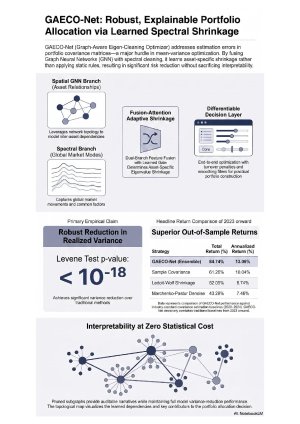
GAECO-Net_Portfolio_Allocation_Model_Overview.pdf
A Regime-Gated Hybrid Forecasting Framework: Coupling Autoregressive Distributed Lags, Smooth-Transition Dynamics, and Kolmogorov–Arnold Residual Learning
Mitigating Portfolio Risk via Machine Learning Across Market Regimes: Hierarchical Clustering vs. PCA Matrix Denoising.