Event submissions
Published
This submission belongs to the session S2. Machine Learning for Next-Generation Risk Modeling of the event The 2nd International Online Conference on Risk and Financial Management
Published date
28 Oct, 2026
Academic Editor
 Thanasis Stengos
Citation
Harsh Milind Tirhekar, Regime-Conditioned Convolutional Autoencoders with Recurrent Networks for Implied Volatility Surface Forecasting, in Proceedings of The 2nd International Online Conference on Risk and Financial Management, 2 November–4 November 2026, MDPI: Basel, Switzerland
Share
Email
Facebook
Twitter
LinkedIn
Regime-Conditioned Convolutional Autoencoders with Recurrent Networks for Implied Volatility Surface Forecasting

Harsh Milind Tirhekar 1
1. Department of Computer Science, College of Natural Sciences, The University of Texas at Austin, Austin, Texas, United States.
Abstract
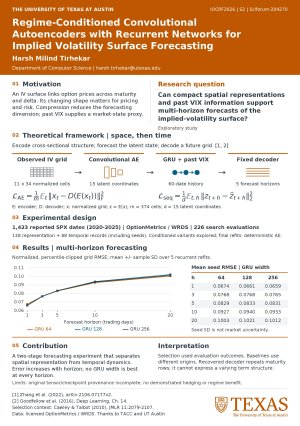
Accurate forecasting of the Implied Volatility Surface (IVS) is a fundamental challenge in financial engineering, derivatives pricing, hedging, and risk management due to the high-dimensionality of option grids and non-linear market dynamics. Traditional models struggle with complex patterns, while standard deep learning architectures suffer from noise. This paper presents a novel two-stage deep learning framework for IVS forecasting that combines (1) a regime-conditioned convolutional autoencoder that learns latent representations of daily 11x34 IVS grids conditioned on the VIX regime, and (2) temporal sequence models (LSTM, GRU, Transformer) that forecast future latent vectors. Using 1,423 daily S&P 500 IVS grids from OptionMetrics (2020–2025) via WRDS, we conduct a comprehensive 226-configuration hyperparameter sweep. Our best model, a GRU with a 60-day lookback window, achieves out-of-sample RMSE of 0.066 for 1-day, 0.083 for 5-day, and 0.100 for 20-day horizons. This represents a 5.7% RMSE improvement over the persistence baseline at the 20-day horizon. Although the Diebold-Mariano test indicates that this difference is not statistically significant at the 5% level (p=0.646) due to limited test set size, the model demonstrates consistent directional outperformance. The findings show that a 60-day context window is optimal, GRUs outperform Transformers at this data scale, and the autoencoder's reconstruction floor sets a bound on forecasting accuracy. The framework provides interpretable representations that correlate cleanly with market indicators, offering a robust tool for risk management.
Keywords
implied volatility surface
deep learning
convolutional autoencoders
regime-conditioned forecasting
risk modeling
Poster
Sciforum-204270_Poster_UT_Research.pdf
Mitigating Portfolio Risk via Machine Learning Across Market Regimes: Hierarchical Clustering vs. PCA Matrix Denoising.
Artificial intelligence for Stock index prediction: A systematic review on Africa