Event submissions
Published
This submission belongs to the session S2. Machine Learning for Next-Generation Risk Modeling of the event The 2nd International Online Conference on Risk and Financial Management
Published date
28 Oct, 2026
Academic Editor
 Thanasis Stengos
Citation
Hajar OUANNOU, Youness Zerhouni LAQRIB, Artificial intelligence for Stock index prediction: A systematic review on Africa, in Proceedings of The 2nd International Online Conference on Risk and Financial Management, 2 November–4 November 2026, MDPI: Basel, Switzerland
Share
Email
Facebook
Twitter
LinkedIn
Artificial intelligence for Stock index prediction: A systematic review on Africa

Hajar OUANNOU 1
Youness Zerhouni LAQRIB 1
1. Faculty of Legal, Economic and Social Sciences of Meknes, Morocco (FSJES), University Moulay Ismail of Meknes (UMI), Meknes, 50000, Morocco
Abstract
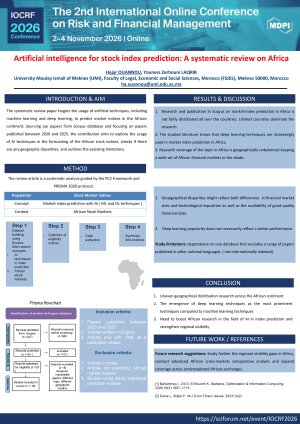
Artificial intelligence (AI) and machine learning (ML) are increasingly utilised in financial market forecasting, offering advanced capabilities to capture the complexity of stock market fluctuations. However, targeted, comprehensive syntheses focusing on emerging African markets remain scarce despite a growing body of broader global reviews. The existing literature is often fragmented across individual countries, making it challenging to understand the African context. Following PRISMA 2020 guidelines, this systematic review analyses English-language studies published between 2020 and 2025 from the Scopus database. The present study evaluates the application of machine learning (ML), deep learning (DL), and hybrid models in predicting African stock indices. The findings reveal that index prediction using artificial intelligence techniques remains unevenly distributed across the continent. Current literature is heavily concentrated on four primary markets that are viewed as the most established and which are characterised by greater financial development and data availability: Nigeria (NGX All Share), South Africa (JSE ALSI), Morocco (MASI), and Egypt (EGX30). Across standard performance metrics, deep learning architectures consistently emerge as the most prominent and effective predictive approaches. By synthesising the current state of research, this study uncovers regional visibility gaps, identifies critical data quality limitations, and provides actionable recommendations to advance cross-market comparative analysis and expand coverage across underexplored African exchanges.
Keywords
systematic review
financial markets
stock index prediction
artificial intelligence
Africa
Poster
Poster - Artificial intelligence for Stock index prediction A systematic review on Africa.pdf
Regime-Conditioned Convolutional Autoencoders with Recurrent Networks for Implied Volatility Surface Forecasting
Machine-Learned Scarcity Numeraires for Water–Energy Risk and Sustainable Asset Valuation