Event submissions
Published
This submission belongs to the session S2. Machine Learning for Next-Generation Risk Modeling of the event The 2nd International Online Conference on Risk and Financial Management
Published date
28 Oct, 2026
Academic Editor
 Thanasis Stengos
Citation
SARA CHEGDAL, Mustapha Kabil, Abdeljalil Settar, Patch-VTT: A Memory-Efficient Transformer for Volatility-Based Anomaly Detection and Risk-Off Portfolio Management, in Proceedings of The 2nd International Online Conference on Risk and Financial Management, 2 November–4 November 2026, MDPI: Basel, Switzerland
Share
Email
Facebook
Twitter
LinkedIn
Patch-VTT: A Memory-Efficient Transformer for Volatility-Based Anomaly Detection and Risk-Off Portfolio Management

SARA CHEGDAL 1
Mustapha Kabil 1
Abdeljalil Settar 1
1. Laboratory of Mathematics, Computer Science and Applications (LMCSA), Faculty of Sciences and Techniques of Mohammedia (FSTM), Hassan II University of Casablanca, Mohammedia 28806, Morocco.
Abstract
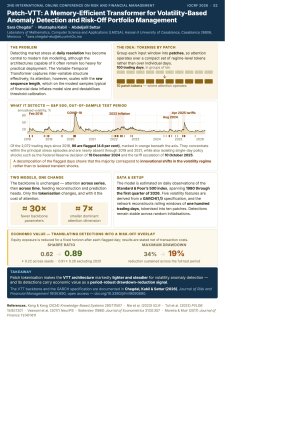
Detecting market stress at daily resolution is central to modern risk modeling, yet the deep architectures capable of it are often too heavy to be practical. The Variable-Temporal Transformer (VTT) captures inter-variable structure effectively [1], but its attention scales with the raw sequence length, inflating model size and destabilizing threshold calibration on the small samples typical of financial data. We introduce Patch-VTT, which tokenizes each input window into patches [2] so that attention operates over compact regime-level tokens rather than individual days. Using S&P 500 daily data from 1980 to 2026, we build five volatility features from a GARCH(1,1) model [3] and reconstruct 100-day windows through a patched variable-temporal backbone, combined with a cross-attention head that restores per-day resolution and a rank-based fusion of the patch and point reconstruction errors. Days whose fused error exceeds the 95th percentile of the validation distribution are flagged. The patched design cuts the backbone parameter count by roughly thirtyfold and its dominant attention dimension by close to sevenfold, while yielding detections stable across random initializations. The model recovers the principal stress episodes of 2018 to 2025, and most flagged days correspond to innovational volatility-regime shifts rather than isolated shocks [4]. A risk-off overlay that reduces equity exposure following each flag raises the Sharpe ratio from 0.62 to 0.89±0.22 and lowers the maximum drawdown from 34% to 19% relative to buy-and-hold; the improvement persists once the 2020 crisis is excluded (Sharpe ratio 0.91±0.26). Patch tokenization thus makes transformer-based volatility detection lighter and steadier, with period-robust economic value.
References:
Kang, H., & Kang, P. (2024). Transformer-based multivariate time series anomaly detection using inter-variable attention mechanism. Knowledge-Based Systems, 290, 111507.
Nie, Y., Nguyen, N. H., Sinha, P., & Kalagnanam, J. (2023). A time series is worth 64 words: Long-term forecasting with transformers. ICLR.
Bollerslev, T. (1986). Generalized autoregressive conditional heteroskedasticity. Journal of Econometrics, 31(3), 307–327.
Chen, C., & Liu, L. M. (1993). Joint estimation of model parameters and outlier effects in time series. JASA, 88(421), 284–297.
Keywords
anomaly detection
transformers
GARCH volatility
patch tokenization
volatility-managed portfolios
risk management
Poster
IOCRF2026_poster_ CHEGDAL-SARA.pdf
LSTM-Based Financial Forecasting with Interpretability:Evidence from US Equity Markets
Does Global News Tone Add Predictive Value for Market Stress? Out-of-Sample Evidence from GDELT and the VIX