Event submissions
Published
This submission belongs to the session S2. Machine Learning for Next-Generation Risk Modeling of the event The 2nd International Online Conference on Risk and Financial Management
Published date
28 Oct, 2026
Academic Editor
 Thanasis Stengos
Contribution&Funding
Conceptualization,
[Amos Olaolu Adewusi] ; [Akuakanwa Eziukwu Nwosu]
Methodology,
[Olajumoke Folasade Jejelola] ; [Amos Olaolu Adewusi]
Validation,
[Amos Olaolu Adewusi] ; [Akuakanwa Eziukwu Nwosu]
Formal analysis,
[Olajumoke Folasade Jejelola]
Resources,
[Olajumoke Folasade Jejelola] ; [Akuakanwa Eziukwu Nwosu]
Writing - original draft,
[Olajumoke Folasade Jejelola]
Writing - review,
[editing] ; [Olajumoke Folasade Jejelola] ; [Amos Olaolu Adewusi] ; [Akuakanwa Eziukwu Nwosu]
Supervision,
[Amos Olaolu Adewusi] ; [Akuakanwa Eziukwu Nwosu]
Funding: --
Citation
Olajumoke Folasade Jejelola, Amos Olaolu Adewusi, Akuakanwa Eziukwu Nwosu, Mapping the Evolution of Machine Learning for Mortgage Repayment Prediction: A Bibliometric Analysis and Research Agenda for Automated Decision-Support Systems, in Proceedings of The 2nd International Online Conference on Risk and Financial Management, 2 November–4 November 2026, MDPI: Basel, Switzerland
Share
Email
Facebook
Twitter
LinkedIn
Mapping the Evolution of Machine Learning for Mortgage Repayment Prediction: A Bibliometric Analysis and Research Agenda for Automated Decision-Support Systems

Olajumoke Folasade Jejelola 1
Amos Olaolu Adewusi 2
Akuakanwa Eziukwu Nwosu 2
1. Estate Management, Adekunle Ajasin University Akungba Akoko, Akure, 3382, Nigeria
2. Estate Management, Federal University of Technology, Akure, Akure, 3382, Nigeria
Abstract
Machine learning (ML) has emerged as a transformative technology for mortgage repayment prediction, offering significant improvements in credit risk assessment, underwriting, and lending decision-making. Despite the rapid growth of research in this field, the intellectual structure, collaboration patterns, thematic evolution, and emerging research directions remain fragmented. This study presents a comprehensive bibliometric analysis of machine learning research on mortgage repayment prediction using 34 journal articles retrieved from the Scopus database covering the period 2000–2025. Following the PRISMA 2020 guidelines, bibliographic records were analyzed using VOSviewer to examine annual scientific production, country contributions, citation patterns, source impact, author collaboration, and keyword co-occurrence.
The findings reveal a substantial increase in research output from 2018 onwards, reflecting growing scholarly interest in applying artificial intelligence to mortgage lending. The United States emerged as the leading contributor in terms of publications and citation impact, while Expert Systems with Applications and Computational Economics were identified as the most influential publication sources. Keyword network analysis revealed four dominant research themes: credit risk assessment and default prediction, machine learning classification algorithms, predictive analytics and forecasting, and deep learning-based credit scoring. Temporal and density visualization indicate that the field has evolved from conventional statistical modelling towards advanced ensemble learning and explainable artificial intelligence, although limited attention has been devoted to automated decision-support systems and practical model deployment.
The study concludes that future research should move beyond algorithm comparison towards the development of explainable, automated, and context-specific decision-support systems capable of supporting transparent and intelligent mortgage lending. The findings provide valuable insights for researchers, financial institutions, policymakers, and developers seeking to advance artificial intelligence applications in mortgage finance.
Keywords
Machine Learning; Mortgage Repayment Prediction; Artificial Intelligence; Credit Risk Assessment; Decision-Support systems;
Poster
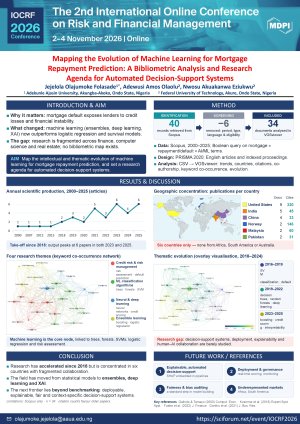
IOCRF2026_Poster_ML_Mortgage_Repayment_Bibliometrics.pdf
Does Global News Tone Add Predictive Value for Market Stress? Out-of-Sample Evidence from GDELT and the VIX
Does Machine Learning Outperform Traditional Scorecards? Evidence from a Benchmark Credit Risk Dataset