Event submissions
Published
This submission belongs to the session S2. Machine Learning for Next-Generation Risk Modeling of the event The 2nd International Online Conference on Risk and Financial Management
Published date
28 Oct, 2026
Academic Editor
 Thanasis Stengos
Citation
Fahim Sufi, AI Enabled Cyber Risk Salience Measurement from Global Cybersecurity News Metadata, in Proceedings of The 2nd International Online Conference on Risk and Financial Management, 2 November–4 November 2026, MDPI: Basel, Switzerland
Share
Email
Facebook
Twitter
LinkedIn
AI Enabled Cyber Risk Salience Measurement from Global Cybersecurity News Metadata

Fahim Sufi 1,2
1. Office of CTO, COEUS Institute, New Market, VA 22844, USA
2. CTI, University of Dhaka, Dhaka 1000, Bangladesh
Abstract
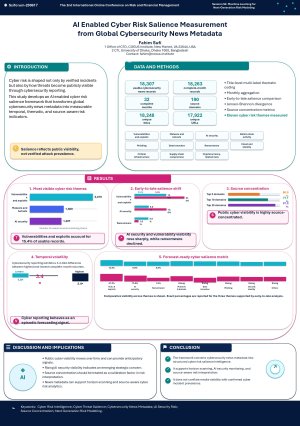
Introduction: Cyber risk is shaped not only by verified incidents, but also by how threats become publicly visible through cybersecurity reporting. For risk modelling, this visibility matters because it influences organisational attention, policy concern, investment priorities, and perceptions of emerging digital threats. This study develops an AI enabled cyber risk salience framework for converting global cybersecurity news metadata into measurable temporal, thematic, and source aware risk indicators.
Methods: The study analyses 18,307 usable cybersecurity news records collected between 3 October 2023 and 2 June 2026. Complete month analysis uses 18,263 records across 32 months, drawn from 190 source domains, 18,248 unique titles, and 17,922 unique URLs. The framework combines title level multi label thematic coding, monthly aggregation, early to late salience comparison, Jensen Shannon divergence, and source concentration metrics. Eleven cyber risk themes were measured, including vulnerabilities and exploits, malware and botnets, AI security, nation state activity, phishing, data breaches, ransomware, cloud and identity, critical infrastructure, supply chain compromise, and cryptocurrency related risks.
Results: Cybersecurity reporting showed marked temporal volatility, with a 3.4 fold difference between the highest and lowest complete month volumes. The most visible theme was vulnerabilities and exploits, appearing in 2,816 records, or 15.4% of usable records, followed by malware and botnets with 1,509 records and AI security with 1,407 records. Late period cyber risk salience increased most strongly for vulnerabilities and exploits, from 13.5% to 21.3%, and AI security, from 6.0% to 13.6%, while ransomware declined from 5.8% to 1.6%. Source concentration was substantial, with the top five domains contributing 60.9%, the top ten 77.1%, and the top twenty 91.5% of all records.
Conclusions: This study contributes to next generation risk modelling by showing how cybersecurity news metadata can be transformed into structured cyber risk salience intelligence. The framework supports horizon scanning, AI security monitoring, source aware risk interpretation, and public cyber risk analytics without conflating news visibility with verified attack prevalence.
Keywords
Cyber Risk Intelligence
Cyber Threat Salience
Cybersecurity News Metadata
AI Security Risk
Source Concentration
Next Generation Risk Modelling
Poster
AI_Enabled_Cyber_Risk_Salience_Poster_Editable.pdf
Does Machine Learning Outperform Traditional Scorecards? Evidence from a Benchmark Credit Risk Dataset
EAGLE: Execution-Aware Gated Learning for Cost-Robust Multi-Agent Trading Systems