Event submissions
Published
This submission belongs to the session S2. Machine Learning for Next-Generation Risk Modeling of the event The 2nd International Online Conference on Risk and Financial Management
Published date
28 Oct, 2026
Academic Editor
 Thanasis Stengos
Citation
Keshav Agarwal, EAGLE: Execution-Aware Gated Learning for Cost-Robust Multi-Agent Trading Systems, in Proceedings of The 2nd International Online Conference on Risk and Financial Management, 2 November–4 November 2026, MDPI: Basel, Switzerland
Share
Email
Facebook
Twitter
LinkedIn
EAGLE: Execution-Aware Gated Learning for Cost-Robust Multi-Agent Trading Systems

Keshav Agarwal 1
1. CHCI, Indian Institute of Technology Mandi, Mandi, 175005, India
Abstract
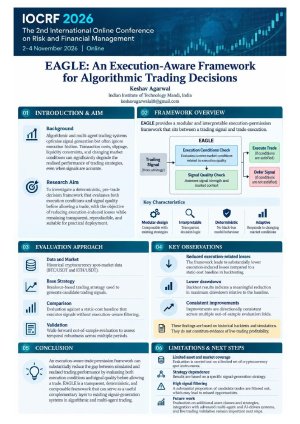
Multi-agent trading systems optimise signal generation but systematically neglect execution friction, the gap between simulated and live performance that arises from transaction costs rather than signal quality. This paper introduces EAGLE-Adaptive, a deterministic pre-trade permission framework that addresses this gap through the Signal-Execution Compatibility Score (SECS), a four-component composite metric evaluating slippage quality, volatility momentum, liquidity depth, and regime stability via a weighted harmonic mean. Unlike prior approaches that rely on hand-tuned parameters, SECS weights are optimised through exhaustive grid search with walk-forward validation, providing a reproducible and data-driven optimisation procedure. A dual-gate architecture independently evaluates execution quality and signal quality before permitting any trade, while an online adaptive threshold responds to non-stationary market conditions without requiring batch retraining of model weights. Empirical evaluation on multi-year cryptocurrency market data demonstrates that EAGLE-Adaptive achieves statistically significant and temporally consistent reductions in execution-induced loss relative to static-cost controls, with improvements confirmed across all out-of-sample validation folds. The framework is fully deterministic, interpretable, and composable with existing signal-generation architectures, demonstrated here using a breakout strategy, thereby enabling integration with broader AI-driven and multi-agent trading pipelines. These results suggest that execution-aware permission mechanisms can substantially reduce the gap between simulated and live trading performance while remaining transparent, reproducible, computationally efficient, and suitable for practical deployment in cost-sensitive algorithmic trading environments.
Keywords
signal-execution compatibility
pre-trade permission
transaction cost analysis
multi-agent trading
grid search optimisation
cryptocurrency trading
Poster
EAGLE_ Execution-Aware Trading Framework.pdf
AI Enabled Cyber Risk Salience Measurement from Global Cybersecurity News Metadata
Tool-Induced Analytical Variance in Credit Risk Exploration: A Comparative Study Using Python, SQL, and Power BI