Event submissions
Published
This submission belongs to the session S2. Machine Learning for Next-Generation Risk Modeling of the event The 2nd International Online Conference on Risk and Financial Management
Published date
28 Oct, 2026
Academic Editor
 Thanasis Stengos
Citation
Moxuan Zheng, Zhen Zhang, Xiao Han, Luyun Lin, Tongchen Zhang, Liancheng Gong, Lixing Lin, Yao Xiao, Do OPEC Relief/Stabilization Signals Improve Brent Volatility Forecasts? State-Dependent Evidence from Monthly Oil Market Reports, in Proceedings of The 2nd International Online Conference on Risk and Financial Management, 2 November–4 November 2026, MDPI: Basel, Switzerland
Share
Email
Facebook
Twitter
LinkedIn
Do OPEC Relief/Stabilization Signals Improve Brent Volatility Forecasts? State-Dependent Evidence from Monthly Oil Market Reports

Moxuan Zheng 1
Zhen Zhang 1
Xiao Han 2
Luyun Lin 3
Tongchen Zhang 4
Liancheng Gong 5
Lixing Lin 6
Yao Xiao 7
1. Independent Researcher, Jersey City, 07302, USA
2. Goizueta Business School, Emory University, Atlanta, 30322, USA
3. Independent Researcher, Dallas, 75201, USA
4. Independent Researcher, Seattle, 98101, USA
5. College of Information, University of Maryland, College Park, College Park, 20742, USA
6. Department of Statistics and Data Science, Yale University, New Haven, 06520, USA
7. College of Computing, Georgia Institute of Technology, Atlanta, 30332, USA
Abstract
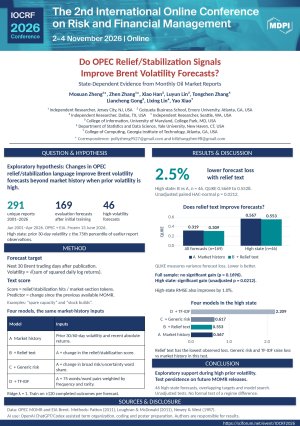
Introduction: Official institutional communication is an underused source for commodity risk forecasting. This paper examines whether the predictive value of relief/stabilization language in OPEC Monthly Oil Market Reports (MOMR) varies with prior oil-market volatility. Methods: The study links 291 unique MOMR publications from January 2001 through April 2026 to daily Brent spot prices from the U.S. Energy Information Administration. Each report is aligned to the first Brent trading day after its verified publication date. A deterministic dictionary measures language about market balance, spare capacity, inventory builds, and supply recovery. An expanding-window ridge model adds the change from the previous available report's dictionary share to a market-history baseline containing lagged volatility and recent absolute returns. Forecasts are assessed using RMSE and variance-form QLIKE, with the state-dependent analysis treated as exploratory. Results: The predictive value of the OPEC text signal is state-dependent. Across 170 full out-of-sample forecasts, the signal produces a modest QLIKE reduction. Among 46 forecasts for which prior 30-trading-day volatility exceeds its expanding 75th percentile, adding the signal reduces QLIKE by 2.7%, a statistically significant improvement under the unadjusted paired HAC-normal test (p = 0.0159). In this high-volatility state, the targeted signal also achieves lower QLIKE than generic risk-dictionary and TF-IDF ridge alternatives. Conclusions: Changes in OPEC relief/stabilization language provide incremental forecasting information when oil markets are already volatile. Future evaluation on new releases can determine whether this state-dependent predictive value persists.
Keywords
OPEC
text mining
forecasting
institutional communication
Brent crude oil
realized volatility
commodity risk
Poster
OPEC_Brent_IOCRF2026_Poster_v3.pdf
Tool-Induced Analytical Variance in Credit Risk Exploration: A Comparative Study Using Python, SQL, and Power BI
AI-Driven Behavioral Risk Modeling for Investor Retention in Wealth Management