Event submissions
Published
This submission belongs to the session S2. Machine Learning for Next-Generation Risk Modeling of the event The 2nd International Online Conference on Risk and Financial Management
Published date
28 Oct, 2026
Academic Editor
 Thanasis Stengos
Citation
Caio Mesquita, Selective Forecasting of Realized Volatility Using Prediction Confidence, in Proceedings of The 2nd International Online Conference on Risk and Financial Management, 2 November–4 November 2026, MDPI: Basel, Switzerland
Share
Email
Facebook
Twitter
LinkedIn
Selective Forecasting of Realized Volatility Using Prediction Confidence

Caio Mesquita 1
1. ICPA – Federal University of Itajubá (UNIFEI), Itabira Campus, Itabira, MG, Brazil
Abstract
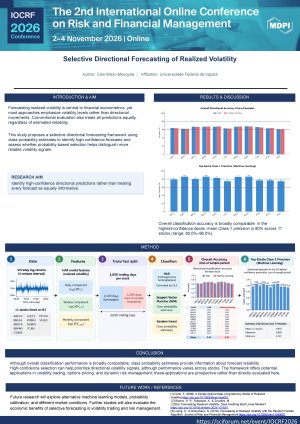
Forecasting realized volatility is a central problem in financial econometrics, where most approaches focus on predicting volatility levels rather than directional movements. This paper proposes a selective forecasting framework that uses class probability estimates to identify high-confidence predictions of realized volatility direction, addressing the limitation of evaluating all forecasts equally.
The empirical analysis covers 11 stocks listed on B3—ABEV3, BBAS3, BBDC4, BRKM5, CSNA3, ELET3, EMBR3, GGBR4, ITUB4, PETR4, and VALE3—providing a diversified cross-section of major Brazilian companies across different sectors. Using a split sample of 3,000 trading days, the first 1,500 observations are used for estimation and the remaining 1,500 for fixed out-of-sample evaluation. This static design isolates the contribution of confidence-based forecast selection from the effects of repeated parameter re-estimation. A Heterogeneous Autoregressive (HAR) model estimated by OLS serves as the benchmark directional classifier, while Support Vector Machine (SVM) and Random Forest models are trained using the same explanatory variables and provide class probability estimates.
The results indicate that overall classification performance is broadly comparable across models. However, predicted probabilities contain relevant information about forecast reliability. In the highest-confidence decile, precision reaches 90.9% for BBAS3 and EMBR3 and exceeds 80% for BBDC4 and GGBR4. Across the 11 stocks, average precision in the highest-confidence decile is approximately 78.5%, while low-confidence predictions exhibit substantially weaker performance.
These findings suggest that probability estimates provide information beyond directional forecasts and can support selective forecasting strategies. By focusing on predictions with sufficiently high confidence, the framework offers practical applications in volatility trading, options pricing, and dynamic risk management.
Keywords
Realized volatility
Volatility forecasting
Machine learning
Selective forecasting
Prediction confidence
Probabilistic classification
Poster
IOCRF2026_Poster.pdf
AI-Driven Behavioral Risk Modeling for Investor Retention in Wealth Management
Margin Compression Without Fee Substitution: Evidence from Euro Area Negative Rate Policy