Event submissions
Published
This submission belongs to the session S2. Machine Learning for Next-Generation Risk Modeling of the event The 2nd International Online Conference on Risk and Financial Management
Published date
28 Oct, 2026
Academic Editor
 Thanasis Stengos
Citation
Dragos Bozdog, Mohammad Shipon, Yash Deelip Karbhari, Detection of Market Stress Through Adaptive Liquidity-Scaling Signals, in Proceedings of The 2nd International Online Conference on Risk and Financial Management, 2 November–4 November 2026, MDPI: Basel, Switzerland
Share
Email
Facebook
Twitter
LinkedIn
Detection of Market Stress Through Adaptive Liquidity-Scaling Signals

Dragos Bozdog 1
Mohammad Shipon 1
Yash Deelip Karbhari 2
1. School of Business, Stevens Institute of Technology, Hoboken, NJ 07030, USA
2. School of Engineering and Science, Stevens Institute of Technology, Hoboken, NJ 07030, USA
Abstract
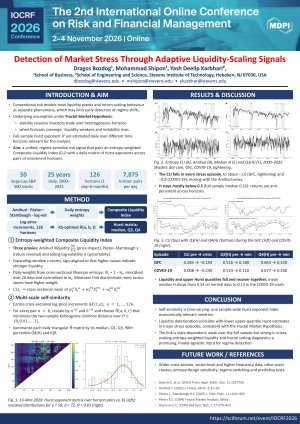
Conventional risk models often treat liquidity events and return-scaling behaviors as separate phenomena, which limits early detection of regime shifts. This study introduces a unified risk-modeling framework that links an entropy-weighted Composite Liquidity Index (CLI) with a distribution-based measure of time-varying self-similarity to produce an adaptive, regime-sensitive risk signal.
The CLI aggregates three liquidity proxies, Amihud illiquidity, the Pastor–Stambaugh liquidity factor, and rolling log-volatility, with weights that adjust daily based on each measure's cross-sectional discriminatory power rather than fixed weighting. In parallel, a matrix of Hurst exponents is estimated by minimizing Kolmogorov–Smirnov distances between rescaled return distributions across pairs of investment horizons, yielding a non-parametric indicator of scaling stability. The framework is applied to daily data for 50 large-cap S&P 500 constituents from 2000 to 2025.
The composite liquidity signal and the median Hurst exponent decline jointly during major stress episodes, including the Dot-Com Crash, the Global Financial Crisis, the COVID-19 shock, and the recent monetary tightening cycle. Dispersion in the Hurst-exponent matrix widens during these periods, indicating that scaling behavior becomes increasingly fragmented across horizons as liquidity conditions deteriorate.
Entropy-adaptive liquidity weighting combined with fractal scaling diagnostics provides an extensible, model-agnostic building block for next-generation risk models. The framework enables detection of liquidity-driven instability and non-stationary return dynamics, with potential extensions to sector-level analysis, higher-frequency data, and alternative asset classes.
Keywords
Risk Modeling
Regime Detection
Adaptive Weighting
Liquidity Risk
Fractal Scaling
Entropy
Poster
Poster_IOCRF_2026_Shipon_Karbhari_Bozdog_A1.pdf
Margin Compression Without Fee Substitution: Evidence from Euro Area Negative Rate Policy
Machine Learning-Based Risk Modeling for Operational Performance and Cost Optimization in Fecal Sludge Treatment Plants: A Decision Support Framework for Urban Sanitation