Event submissions
Published
This submission belongs to the session S2. Machine Learning for Next-Generation Risk Modeling of the event The 2nd International Online Conference on Risk and Financial Management
Published date
28 Oct, 2026
Academic Editor
 Thanasis Stengos
Citation
Florette Léocadie Mouakem Ninla, Machine Learning-Based Risk Modeling for Operational Performance and Cost Optimization in Fecal Sludge Treatment Plants: A Decision Support Framework for Urban Sanitation, in Proceedings of The 2nd International Online Conference on Risk and Financial Management, 2 November–4 November 2026, MDPI: Basel, Switzerland
Share
Email
Facebook
Twitter
LinkedIn
Machine Learning-Based Risk Modeling for Operational Performance and Cost Optimization in Fecal Sludge Treatment Plants: A Decision Support Framework for Urban Sanitation

Florette Léocadie Mouakem Ninla 1
1. Department of Sanitation and Environmental Engineering, International Institute for Water and Environmental Engineering (2iE), Ouagadougou 01 BP 594, Ouagadougou, Burkina Faso.
Abstract
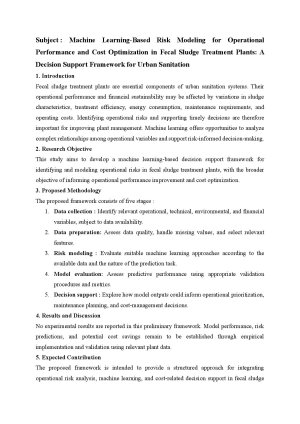
Urban sanitation services in many low- and middle-income countries face growing operational and financial risks due to rapid urbanization, inadequate monitoring systems, and inefficient resource allocation. Fecal sludge treatment plants (FSTPs) are particularly vulnerable to fluctuating sludge inflows, equipment failures, rising operational costs, and limited data-driven decision-making. These challenges reduce treatment efficiency and threaten the sustainability of sanitation services.
This study proposes a machine learning-based framework to model operational and economic risks in FSTPs and support evidence-based decision-making, using SECA Cameroon as a case study. The framework integrates operational, financial, and environmental data to identify key factors affecting plant performance and operating costs. Machine learning algorithms are applied to predict risk scenarios, estimate cost variations, and detect patterns associated with reduced treatment efficiency.
The proposed framework enhances infrastructure management through predictive maintenance, optimized resource allocation, and strategic planning. It also supports the digital transformation of sanitation services by providing an intelligent decision-support system capable of generating timely recommendations for plant managers and policymakers.
This research addresses the urgent need for data-driven risk management in rapidly urbanizing African cities, where financial constraints and operational uncertainties often compromise service delivery. By combining machine learning with data analytics, the framework demonstrates how artificial intelligence can strengthen operational resilience, improve cost efficiency, and support sustainable urban sanitation management.
The study contributes a scalable and adaptable decision-support model that can be implemented in different sanitation contexts. Its findings provide practical insights for utility operators, policymakers, and researchers seeking to improve infrastructure performance through next-generation risk modeling and data-driven decision-making.
Keywords
Machine Learning
Risk Modeling
Fecal Sludge Management
Urban Sanitation
Artificial Intelligence
Cost Optimization
Decision Support System
Sustainable Infrastructure
Poster
resumé_iocrf2026.pdf
Detection of Market Stress Through Adaptive Liquidity-Scaling Signals
PREDICTIVE ANALYTICS FOR MARKET RISK: AI MODELING FOR STOCK PRICE FORECASTING AND HEDGING STRATEGIES