Event submissions
Published
This submission belongs to the session S2. Machine Learning for Next-Generation Risk Modeling of the event The 2nd International Online Conference on Risk and Financial Management
Published date
28 Oct, 2026
Academic Editor
 Thanasis Stengos
Citation
Amna BOUHOREIRA, Fatima Zohra BEKADDOUR, Predicting Default Risk in Buy Now, Pay Later Services: A Comparative Study of Random Forest and XGBoost, in Proceedings of The 2nd International Online Conference on Risk and Financial Management, 2 November–4 November 2026, MDPI: Basel, Switzerland
Share
Email
Facebook
Twitter
LinkedIn
Predicting Default Risk in Buy Now, Pay Later Services: A Comparative Study of Random Forest and XGBoost

Amna BOUHOREIRA 1
Fatima Zohra BEKADDOUR 1
1. Department of Accounting and Finance
Faculty of Economic, Ghardaia.
University of Ghardaia
P.O. Box 455 Zone scientifique Ghardaïa, 47000, Algeria
Abstract
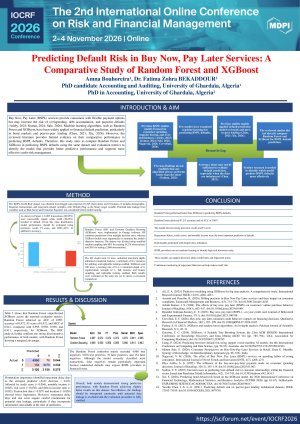
Buy Now, Pay Later (BNPL) has emerged as one of the fastest-growing segments of the global financial technology (FinTech) industry, offering consumers flexible payment options while creating new challenges in credit risk management. The rapid expansion of BNPL services has increased the likelihood of borrower defaults, making accurate and timely default prediction essential for maintaining portfolio quality and supporting sustainable lending practices. This study investigates the application of supervised machine learning techniques for binary classification to predict whether BNPL users are likely to default or successfully repay their obligations. Two widely used ensemble learning algorithms, Random Forest and XGBoost, were developed and compared using a dataset comprising 10,345 BNPL transactions.
Model performance was evaluated using four key metrics: Accuracy, Area Under the Receiver Operating Characteristic Curve (AUC-ROC), Recall, and the F1-score. Experimental results indicate that the Random Forest model consistently outperformed the XGBoost model, achieving an overall accuracy of 97% while demonstrating superior discriminative capability in distinguishing between defaulting and non-defaulting customers. The findings highlight the potential of machine learning methods to strengthen credit risk assessment by providing more accurate and reliable default predictions. Consequently, these predictive models can support financial technology institutions in enhancing lending decisions, minimizing credit losses, optimizing risk management strategies, and promoting responsible growth within the rapidly expanding BNPL ecosystem.
Keywords
Buy Now - Pay Later (BNPL)
Machine Learning
Credit Risk Assessment
Default Prediction
Random Forest
XGBoost.
Poster
Predicting Default Risk in Buy Now, Pay Later Services A Comparative Study of Random Forest and XGBoost.pdf
Machine Learning for Rare-Event Bank Failure Ranking: Rolling Out-of-Sample Evidence from Public FDIC Data
AI-Driven Dynamic Asset Pricing with Regime Switching and Nonlinear Risk Premia