Event submissions
Published
This submission belongs to the session S2. Machine Learning for Next-Generation Risk Modeling of the event The 2nd International Online Conference on Risk and Financial Management
Published date
28 Oct, 2026
Academic Editor
 Thanasis Stengos
Citation
Mohammad Shahriar Azad Bhuiyan, Currency-Specific Exchange Rate Pass-Through under Monetary Policy Thresholds and Structural Breaks: SVECM Evidence from the United States, in Proceedings of The 2nd International Online Conference on Risk and Financial Management, 2 November–4 November 2026, MDPI: Basel, Switzerland
Share
Email
Facebook
Twitter
LinkedIn
Currency-Specific Exchange Rate Pass-Through under Monetary Policy Thresholds and Structural Breaks: SVECM Evidence from the United States

Mohammad Shahriar Azad Bhuiyan 1
1. Research and Internal Control & Risk Management Department, UniCap Securities Limited, Dhaka, 1000, Bangladesh
Abstract
Introduction: Empirical research on exchange rate pass-through typically treats currencies as uniformly influential and overlooks regime shifts induced by systemic crises, potentially biasing estimates of currency risk and monetary policy effectiveness. This paper addresses three gaps—currency homogenization, neglect of structural breaks, and uniform treatment of monetary policy transmission—in what is, to the author's knowledge, one of the first unified frameworks evaluating currency-specific pass-through, monetary thresholds, and crisis-related structural breaks for the United States.
Methods: A Structural Vector Error Correction Model (SVECM) is estimated using quarterly U.S. data for GDP, the Federal Funds Rate, GBP/USD, JPY/USD, and oil prices from 1985Q1–2024Q2, and for EUR/USD from 1999Q1–2024Q2, reflecting the euro's introduction. The model jointly evaluates these series alongside Bai–Perron multiple breakpoint tests identifying structural regime shifts. Robustness is assessed using Bayesian VAR and threshold VECM specifications, Hansen threshold tests, and bootstrap impulse response analysis.
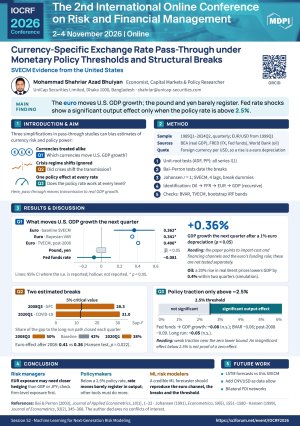
Results: The euro dominates U.S. growth transmission: a 1% euro depreciation increases next-quarter GDP by 0.36% (p < 0.05), while the British pound and Japanese yen have negligible effects. Bai–Perron tests identify structural breaks at 2008Q3 and 2020Q1, with euro pass-through strengthening after the Global Financial Crisis (0.41 vs. 0.36). Monetary transmission is nonlinear: Federal Funds Rate shocks significantly affect output only above a 2.5% threshold, confirming weak policy traction near the zero lower bound. Oil price shocks form a secondary transmission channel, with a 20% increase reducing GDP by 0.4% within two quarters.
Conclusions: Exchange rate pass-through is a currency-specific, regime-dependent mechanism rather than a uniform process. To the extent that firm- and portfolio-level currency exposure tracks the aggregate transmission channel identified here, these results suggest euro exposure may warrant closer risk-management attention than GBP or JPY exposure; macroeconomic stabilization, meanwhile, requires alternative policy instruments when interest rates fall below identified thresholds. The results establish an econometric benchmark for next-generation risk modeling, providing a reference against which machine learning approaches to macro-financial forecasting can be evaluated.
Keywords
Exchange rate pass-through
monetary policy thresholds
structural breaks
macro-financial risk
risk management
financial forecasting
Poster
M Shahriar Azad Bhuiyan Poster.pdf
Predict, Detect, Defend: A Machine Learning Framework for Next-Generation Cyber Risk Modelling
Forecasting Inflation Using Machine Learning vs. Traditional Time Series Models: Evidence from the Post-Pandemic Period