Event submissions
Published
This submission belongs to the session S2. Machine Learning for Next-Generation Risk Modeling of the event The 2nd International Online Conference on Risk and Financial Management
Published date
28 Oct, 2026
Academic Editor
 Thanasis Stengos
Citation
Florin Laurențiu Nicolae, Iulian-Gabriel Ionescu, Forecasting Inflation Using Machine Learning vs. Traditional Time Series Models: Evidence from the Post-Pandemic Period, in Proceedings of The 2nd International Online Conference on Risk and Financial Management, 2 November–4 November 2026, MDPI: Basel, Switzerland
Share
Email
Facebook
Twitter
LinkedIn
Forecasting Inflation Using Machine Learning vs. Traditional Time Series Models: Evidence from the Post-Pandemic Period

Florin Laurențiu Nicolae 1
Iulian-Gabriel Ionescu 1
1. Faculty of International Business and Economics, Bucharest University of Economic Studies, Bucharest, 010404, Romania
Abstract
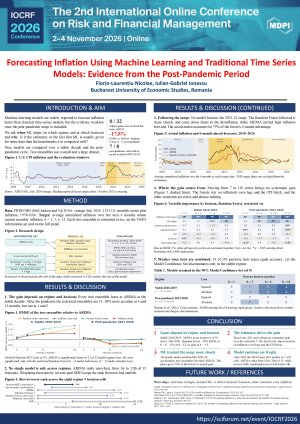
The post-2021 inflationary episode renewed a long-standing question in applied macroeconomic forecasting: whether flexible machine-learning estimators predict inflation more accurately than classical time-series models, and whether any such advantage is concentrated in periods of structural instability rather than being general. This paper compares classical econometric benchmarks with machine-learning estimators over several forecast horizons, using a recursive pseudo-out-of-sample design in which every model setting is determined exclusively from information available before each forecast origin, so that no specification is chosen with knowledge of the period being predicted. Simple naive benchmarks are included alongside the econometric ones, so that any reported gain is measured against a realistic lower bound rather than against a weak comparator. To distinguish the contribution of the model class from that of the volume of information supplied to it, the machine-learning estimators are evaluated twice: once under the same restricted information set available to the classical multivariate benchmark, and once under a substantially broader set of macroeconomic predictors. Forecast accuracy is assessed by standard loss measures and by tests of equal predictive accuracy appropriate to overlapping multi-step forecast errors, and is compared across a period of low and stable inflation and the post-pandemic cycle, the latter extending through the subsequent disinflation. The objective is to establish the conditions under which the additional flexibility of machine-learning methods, and the additional information they can accommodate, translate into practical forecasting gains.
Keywords
macroeconomic forecasting
machine learning
ARIMA
Vector Autoregression
regime shift
post-pandemic inflation
Poster
Poster_IOCRF2026_v4_FINAL.pdf
Currency-Specific Exchange Rate Pass-Through under Monetary Policy Thresholds and Structural Breaks: SVECM Evidence from the United States
Cross-Asset Stress Transmission for Insurance ALM: A Public-Data Early-Warning Framework