Event submissions
Published
This submission belongs to the session S2. Machine Learning for Next-Generation Risk Modeling of the event The 2nd International Online Conference on Risk and Financial Management
Published date
28 Oct, 2026
Academic Editor
 Thanasis Stengos
Citation
Rui Zong, Tianyi Shi, Cross-Asset Stress Transmission for Insurance ALM: A Public-Data Early-Warning Framework, in Proceedings of The 2nd International Online Conference on Risk and Financial Management, 2 November–4 November 2026, MDPI: Basel, Switzerland
Share
Email
Facebook
Twitter
LinkedIn
Cross-Asset Stress Transmission for Insurance ALM: A Public-Data Early-Warning Framework

Rui Zong 1
Tianyi Shi 2
1. Transamerica, Baltimore, MD, 21202, USA
2. Massachusetts Pension Reserve Investment Management, Quincy, MA, 02169, USA
Abstract
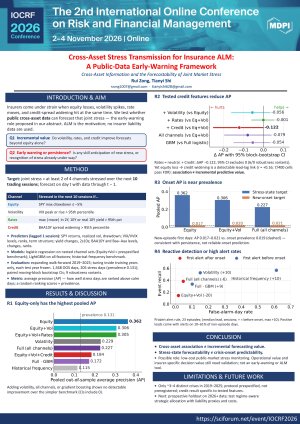
Insurance balance sheets are exposed to stress through multiple market channels, including equity drawdowns, volatility spikes, real-rate shocks, inflation expectations, and credit-spread widening. These channels are often studied separately, yet they interact during crisis periods and can jointly affect asset-liability management, hedging pressure, and strategic allocation decisions. This study proposes a public-data machine-learning framework for measuring and forecasting cross-asset stress transmission from an insurance ALM perspective.
The framework constructs market-pressure indicators from readily available data, including equity returns, VIX-family volatility measures, Treasury yields, TIPS real yields, breakeven inflation, and investment-grade and high-yield credit spreads. These indicators are grouped into equity-volatility pressure, rate and real-yield pressure, and credit-spread pressure. Logistic regression and gradient-boosted decision trees are used to estimate the probability of subsequent market-stress events, allowing both interpretable linear relationships and nonlinear cross-asset interactions to be evaluated. Lead-lag relationships are additionally examined to characterize how stress propagates across equity, volatility, rates, and credit markets.
Model performance is evaluated using an expanding-window out-of-sample design that preserves the temporal ordering of the data and limits look-ahead bias. Predictive performance is assessed using ROC-AUC, precision-recall AUC, Brier score, and recall among the highest predicted-risk observations. Performance is also examined separately during major historical stress regimes, including the 2020 COVID crash, the 2022 inflation and real-rate shock, and the 2023 banking stress episode.
The framework maps observable market conditions to economically interpretable proxies for insurance ALM pressure rather than attempting to replicate proprietary liability valuations. Equity and volatility conditions proxy pressure on equity-linked guarantees and option budgets; Treasury and real-yield movements proxy duration-mismatch pressure; and credit-spread deterioration proxies credit-migration and liquidity pressure in general-account portfolios. The resulting framework is intended as a transparent early-warning layer for risk managers rather than a black-box trading signal. Its contribution is to connect cross-asset market signals and machine-learning forecasts to insurance ALM governance, supporting stress dashboards, regime-aware strategic allocation, and model-risk discussions for insurers managing option-embedded liabilities and long-duration general-account portfolios.
Keywords
insurance ALM
cross-asset stress
financial risk management
early-warning systems
real yields
credit spreads
volatility
strategic asset allocation
Poster
Sciforum-203915 Poster.pdf
Forecasting Inflation Using Machine Learning vs. Traditional Time Series Models: Evidence from the Post-Pandemic Period
A Gaussian Recency Score for Detecting and Directing Central-Bank Policy-Rate Changes