Event submissions
Published
This submission belongs to the session S2. Machine Learning for Next-Generation Risk Modeling of the event The 2nd International Online Conference on Risk and Financial Management
Published date
28 Oct, 2026
Academic Editor
 Thanasis Stengos
Citation
Idrees Mustafa Aziz, A Gaussian Recency Score for Detecting and Directing Central-Bank Policy-Rate Changes, in Proceedings of The 2nd International Online Conference on Risk and Financial Management, 2 November–4 November 2026, MDPI: Basel, Switzerland
Share
Email
Facebook
Twitter
LinkedIn
A Gaussian Recency Score for Detecting and Directing Central-Bank Policy-Rate Changes

Idrees Mustafa Aziz 1
1. Department of Computer Engineering, METU, Ankara, Turkey
Abstract
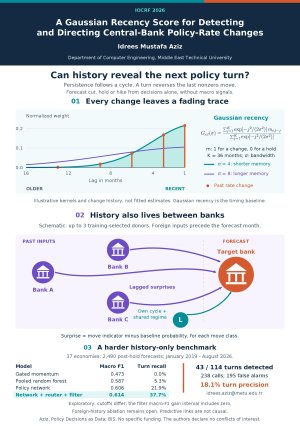
Central bank policy rates change rarely and in discrete steps, which makes both the timing and the direction of the next move difficult to forecast, particularly for models conditioned only on macroeconomic variables. This paper asks how far a bank's own rate history alone can go. We propose a Gaussian-kernel recency score (GPI), which weights recent rate changes by a smooth kernel in the lag, and a hybrid extension (GPIH) that blends this score with an empirical streak hazard, both estimated per country using only in-sample data to avoid leakage. On monthly BIS policy rates spanning 48 economies (3,658 stay-state test months, 768 breaks), GPIH achieves the best F1 score (0.430) and Cohen's kappa (0.204) among all models evaluated, verified using a 10,000-draw country-cluster bootstrap. Under the resulting class imbalance, an always-stay rule is the most accurate single model yet detects no breaks at all; standard machine learning classifiers, including logistic regression, random forest, and XGBoost, given the identical information set, also underperform GPIH by wide and statistically significant margins. We extend the framework to a three-state direction problem (cut, stay, or hike) using separate cut- and hike-specific recency intensities, achieving a macro-F1 of 0.531 while again outperforming the same machine learning benchmarks. Notably, adding cross-excitation terms between cut and hike intensities, or features capturing the length of same-direction cycles, does not improve and can worsen out-of-sample performance. Taken together, the results suggest that recency of recent policy activity, rather than the duration of the current stance or additional model complexity, is the dominant signal available in history-only central-bank policy-rate forecasting.
Keywords
monetary policy
central banking
forecasting
machine learning
time series classification
policy rate
risk modeling
Poster
IOCRF2026 Gaussian Recency Poster.pdf
Cross-Asset Stress Transmission for Insurance ALM: A Public-Data Early-Warning Framework
Trading the Story Before the Price: A Reflexivity-Aware Neural Framework for the Narrative Risk Premium