Event submissions
Published
This submission belongs to the session S2. Machine Learning for Next-Generation Risk Modeling of the event The 2nd International Online Conference on Risk and Financial Management
Published date
28 Oct, 2026
Academic Editor
 Thanasis Stengos
Citation
Prashnatita Pal, Rituparna Bhattacharya, AI-Informed Cyber Risk Governance: An Expected Loss Optimisation Framework for RMF Adoption in Mid-Sized Enterprises, in Proceedings of The 2nd International Online Conference on Risk and Financial Management, 2 November–4 November 2026, MDPI: Basel, Switzerland
Share
Email
Facebook
Twitter
LinkedIn
AI-Informed Cyber Risk Governance: An Expected Loss Optimisation Framework for RMF Adoption in Mid-Sized Enterprises

Prashnatita Pal 1
Rituparna Bhattacharya 2
1. Electronics & Communication Engineering, St Thomas College of Engineering and Technology, Kolkata, 700023, India
2. Computer Science and Engineering, Techno India University West Bengal, Kolkata, 700091, India
Abstract
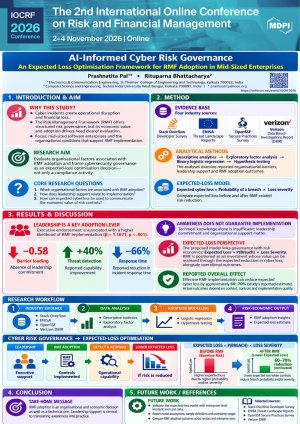
Cybersecurity incidents increasingly generate substantial operational and financial losses, which require organisations to adopt governance approaches that support both risk control and economic decision-making. While the Risk Management Framework (RMF) is widely recognised as a structured mechanism for managing cybersecurity risks, limited research has examined its economic value and the organisational determinants of its adoption. This study addresses this gap by investigating RMF adoption in mid-sized software enterprises from an expected-loss optimisation perspective.
The research integrates evidence from four large-scale industry sources—the Stack Overflow Developer Survey, ENISA Threat Landscape Reports, OpenSSF Secure Practices Survey, and Verizon Data Breach Investigations Report (DBIR). Using descriptive analytics, exploratory factor analysis, binary logistic regression, and hypothesis testing, the study evaluates the organisational factors influencing RMF adoption and assesses its impact on mitigating cyber risks.
The findings reveal a significant disconnect between RMF awareness and implementation, indicating that technical knowledge alone is insufficient to achieve effective risk governance. Leadership support emerges as the most influential organisational factor. The absence of leadership commitment represents the strongest barrier to adoption (loading = −0.58), whereas executive endorsement significantly increases the likelihood of RMF implementation (β = 1.1671, p < .001). Organisations adopting RMF demonstrate measurable operational benefits, including a 40% improvement in threat detection capability and a 66% reduction in incident response time.
To extend existing RMF literature, the study develops an expected-loss evaluation model that links cybersecurity governance with risk economics by representing cyber risk as a combination of breach probability and loss severity. The analysis indicates that effective RMF implementation can reduce expected cyber loss by approximately 60–70%, transforming RMF from a compliance-orientated practice into a quantifiable risk-reduction investment. The proposed framework contributes a novel decision-support perspective for evaluating cybersecurity governance and offers practical guidance for enhancing cyber resilience and organisational risk efficiency.
Keywords
Risk Management Framework (RMF)
Mid-sized enterprises
Software security
Quantitative analysis
Risk analysis
Risk governance adoption
Poster
Sciforum-180439_Prashnatit.pdf
Comparative Analysis of Ensemble Gradient Boosting Classifiers for Credit Default Prediction using ML Optimization Framework
Financial-crime risk in crypto-asset settlement: a reading of the enforcement record