Event submissions
Published
This submission belongs to the session S3. Blockchain and Digital Assets: Frontier Analytics of the event The 2nd International Online Conference on Risk and Financial Management
Published date
28 Oct, 2026
Academic Editor
 Alessio Faccia
Citation
Damir Mihanovic, Božidar Tomašković, Lovorka Blažević, Crypto-Asset Trading Risk Governance, in Proceedings of The 2nd International Online Conference on Risk and Financial Management, 2 November–4 November 2026, MDPI: Basel, Switzerland
Share
Email
Facebook
Twitter
LinkedIn
Crypto-Asset Trading Risk Governance

Damir Mihanovic 1
Božidar Tomašković 2
Lovorka Blažević 2,3
1. Department for Economy, University North-University Center in Koprivnica, Koprivnica, 48000, Croatia
2. Department of Commercial Business and Entrepreneurship, Marko Marulić University of Applied Sciences, Knin, 22300, Croatia
3. Department of Commercial Operations and Entrepreneurship, Marko Marulić University of Applied Sciences, Knin, 22300, Croatia
Abstract
This paper examines crypto-asset trading risk as a multidimensional governance problem within digital financial platforms. It combines a governance-oriented risk framework with empirical evidence derived from daility market data for Bitcoin, Ethereum, Binance Coin and the S&P 500 over the 2020-2025 period. The empirical design integrates descriptive risk indicators, maximum drawdown measures, correlation analysis, event-window analysis surrounding the Terra-Luna collapse, the FTX failure and major MiCA regulatory milestones, and GARCH (1,1) volatility modelling. The findings demonstrate that crypto-assets exhibit substantially higher volatility and deeper drawdowns than the equity-market benchmark, alongside pronounced volatility clustering, persistent conditional variance and event-sensitive downside reactions. Correlations among crypto-assets are generally stronger than their correlations with the S&P 500, indicating limited diversification benefits during period od market stress. The paper contributes to management and platform-governance research by translating market technological, operational, regulatory and behavioral risks into concrete implications for exchanges, custodians, investors and regulators. The results support transparent custody and segregation rules, standardized risk disclosure, continuous volatility and liquidity monitoring, stronger cybersecurity and compliance systems, effective incident-response mechanisms, and targeted investor education. These measures are particularly important as regulatory frameworks such as MiCA seek to improve market integrity, accountability and investor protection without constraining financial innovation.
Keywords
crypto-assets
risk governance
digital platforms
volatility
investor protection
MiCA
Poster
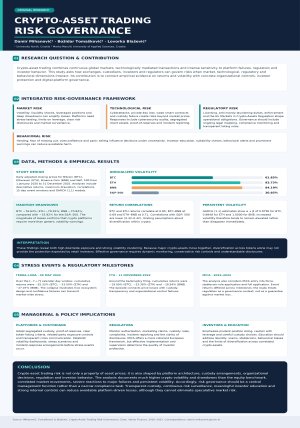
Crypto_Asset_Risk_Governance_Poster_70x100cm_600plus.pdf
From On-Chain Transparency to Organisational Accountability: A Conceptual Framework for Blockchain-Enabled Reporting
Risk Propagation Mechanisms in Decentralized Finance: A PRISMA-Based Systematic Review