Event submissions
Published
This submission belongs to the session S3. Blockchain and Digital Assets: Frontier Analytics of the event The 2nd International Online Conference on Risk and Financial Management
Published date
28 Oct, 2026
Academic Editor
 Alessio Faccia
Citation
Ehsan Derakhshi Ghazijahani, Risk Propagation Mechanisms in Decentralized Finance: A PRISMA-Based Systematic Review, in Proceedings of The 2nd International Online Conference on Risk and Financial Management, 2 November–4 November 2026, MDPI: Basel, Switzerland
Share
Email
Facebook
Twitter
LinkedIn
Risk Propagation Mechanisms in Decentralized Finance: A PRISMA-Based Systematic Review

Ehsan Derakhshi Ghazijahani 1
1. Faculty of Mechanical Engineering, University of Tabriz, Tabriz, 51666-16471, Iran
Abstract
Introduction: Decentralized finance (DeFi) has developed into an interconnected financial ecosystem built on smart contracts, decentralized exchanges, lending protocols, stablecoins, governance mechanisms, price oracles, and cross-chain bridges. Although prior studies identify individual DeFi risks, less attention has been paid to how local failures propagate across protocols and become systemic.
Methods: This study conducts a PRISMA-based systematic literature review of DeFi risk-propagation mechanisms. A total of 76 candidate records were identified, of which 50 studies were retained for qualitative synthesis. The studies were coded according to risk source, transmission channel, amplification mechanism, systemic outcome, and mitigation response.
Results: Seven major risk domains were identified: smart contract risk, oracle risk, liquidity and lending risk, governance and DAO risk, cross-chain bridge risk, stablecoin and depeg risk, and composability-based systemic risk. The findings show that DeFi risks rarely remain isolated. Smart contract exploits, oracle manipulation, liquidation cascades, governance capture, bridge failures, and stablecoin depegging can spread through shared infrastructure, collateral dependencies, automated execution rules, liquidity pools, wrapped assets, and composable protocol interactions. Automation, leverage, common collateral, and infrastructure concentration can amplify these shocks and transform protocol-level failures into ecosystem-wide stress.
Conclusions: The review develops a mechanism-based taxonomy of DeFi risk propagation and shifts analysis from static risk classification toward a dynamic explanation of contagion. It also identifies priorities for future research, including real-time on-chain systemic-risk monitoring, oracle-liquidation feedback loops, DAO governance capture, bridge contagion, and stablecoin depeg transmission.
Keywords
Decentralized finance; DeFi; risk propagation; systemic risk; smart contracts; oracle manipulation; liquidity risk; DAO governance; cross-chain bridges; stablecoins; composability
Poster
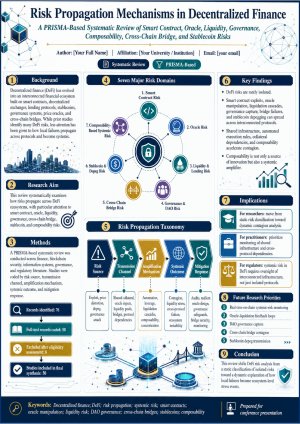
DeFi_Risk_Propagation_Conference_Poster_A1.pdf
Crypto-Asset Trading Risk Governance
Blockchain Technology for Transparency and Fraud Prevention in Supply Chain Management among Food, Beverages and Tobacco manufacturing companies in Nigeria