Event submissions
Published
This submission belongs to the session S4. Data Capitalization: Reconstructing Economic Valuation of the event The 2nd International Online Conference on Risk and Financial Management
Published date
28 Oct, 2026
Academic Editor
 Thanasis Stengos
Citation
Murat Şengöz, Advancing Financial Literacy. Enhancing Knowledge, Behavior, and Resilience in a Digital Era, in Proceedings of The 2nd International Online Conference on Risk and Financial Management, 2 November–4 November 2026, MDPI: Basel, Switzerland
Share
Email
Facebook
Twitter
LinkedIn
Advancing Financial Literacy. Enhancing Knowledge, Behavior, and Resilience in a Digital Era

Murat Şengöz 1
1. Independent Researcher, Ankara, Istanbul, Türkiye
Abstract
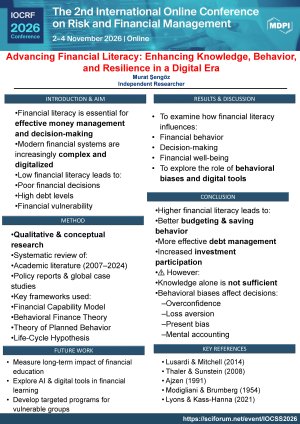
This study examines the role of financial literacy in shaping financial behavior and enhancing individual financial well-being in an increasingly complex and digital financial environment. Financial literacy goes beyond understanding basic concepts; it encompasses the ability to apply knowledge effectively in decision-making related to budgeting, saving, investing, and debt management. Using a qualitative and conceptual research methodology, this study synthesizes existing academic literature, theoretical frameworks, and empirical findings to explore how financial knowledge translates into responsible financial behavior.
The analysis is grounded in key theoretical perspectives, including the Financial Capability Model, Behavioral Finance Theory, the Theory of Planned Behavior, and the Life-Cycle Hypothesis. These frameworks collectively explain the interactions among financial knowledge, psychological biases, and socio-economic factors in influencing financial decisions. The findings indicate that individuals with higher levels of financial literacy are more likely to engage in systematic saving, prudent borrowing, informed investment, and overall effective financial management. However, financial knowledge alone is insufficient, as behavioral biases such as overconfidence, loss aversion, mental accounting, and present bias can hinder optimal decision-making.
The study further highlights the critical role of digital financial tools and emerging technologies in expanding access to financial education and promoting financial inclusion. It identifies significant disparities in financial literacy across demographic groups, emphasizing the need for targeted, culturally sensitive, and inclusive educational strategies. Policy implications include integrating financial education into formal school curricula, expanding community-based programs, and leveraging digital platforms to enhance financial capability at all life stages.
By synthesizing multiple theoretical perspectives and empirical evidence, this study contributes to understanding the dynamic interplay between financial knowledge, behavioral factors, and digital tools in shaping financial behavior. Overall, enhancing financial literacy is essential for fostering individual financial resilience, reducing socio-economic inequality, and supporting long-term economic stability at both personal and societal levels.
Keywords
Financial Literacy
Financial Behavior
Money Management
Financial Outcomes
Financial Education
Behavioral Finance
Poster
K11. POSTER.pdf
Carbon Exposure, Disclosure, and Investment: A TSVF-Based Asset Pricing Study
Data Capitalization and Valuation Paradigm Shift: A Dynamics Model of Valuation Regime Transition