Event submissions
Published
This submission belongs to the session S4. Data Capitalization: Reconstructing Economic Valuation of the event The 2nd International Online Conference on Risk and Financial Management
Published date
28 Oct, 2026
Academic Editor
 Sisira Colombage
Citation
Duresa Kilaj, Argjent Berisha, Revisiting Financial Development: From Financial Depth to Financial Efficiency, in Proceedings of The 2nd International Online Conference on Risk and Financial Management, 2 November–4 November 2026, MDPI: Basel, Switzerland
Share
Email
Facebook
Twitter
LinkedIn
Revisiting Financial Development: From Financial Depth to Financial Efficiency

Duresa Kilaj 1
Argjent Berisha 2
1. Faculty of Business and Economics, South East European University, Tetovo, North Macedonia
2. Faculty of Business, Haxhi Zeka University, Peja, Kosovo
Abstract
Introduction: Financial development has traditionally been assessed through financial depth, commonly measured by indicators such as private credit, bank assets, and market capitalisation. However, a larger financial system does not necessarily imply greater efficiency. While previous studies have focused primarily on financial depth, limited attention has been given to financial efficiency as a distinct dimension of financial development. This study addresses this gap by examining whether greater financial depth translates into higher financial efficiency across selected European economies, thereby providing new evidence on the relationship between the size and effectiveness of financial systems.
Methods: The study employs a balanced panel dataset covering selected European economies from 2004 to 2025, using data obtained from internationally recognised databases. Financial efficiency is measured using the Financial Development Efficiency Index from the IMF Financial Development Database. The empirical analysis applies Ordinary Least Squares (OLS), Fixed Effects (FE), and Random Effects (RE) estimators, supported by standard panel-data diagnostic tests to identify the most appropriate model specification.
Results: The empirical findings reveal a positive and statistically significant relationship between financial depth and financial efficiency across the estimated models, indicating that deeper financial systems tend to allocate financial resources more efficiently. In addition, macroeconomic conditions explain an important share of cross-country variation in financial efficiency, highlighting the role of broader economic fundamentals.
Conclusions: This study contributes to the financial development literature by shifting attention from financial depth to financial efficiency and by distinguishing between the size and effectiveness of financial systems. The findings suggest that financial development should be evaluated not only by the expansion of financial resources but also by the efficiency with which they are allocated and utilised. These results provide useful implications for policymakers seeking to strengthen financial system performance and resilience in an increasingly digital economy.
Keywords
Financial Development
Economic Performance
Financial Depth
Financial Efficiency
Financial Intermediation.
Poster
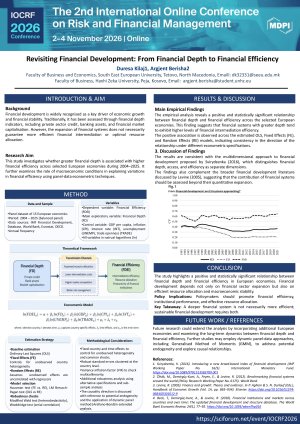
Duresa Kilaj & Argjent Berisha - IOCRF2026 Poster presentation.pdf
Digital Education, Labour Force Transformation, and Sustainable Financial Development
Analysis of the impact of revenue structure on Amazon platform share prices