Event submissions
Published
This submission belongs to the session S4. Data Capitalization: Reconstructing Economic Valuation of the event The 2nd International Online Conference on Risk and Financial Management
Published date
28 Oct, 2026
Academic Editor
 Thanasis Stengos
Contribution&Funding
Conceptualization,
[Constantina Alina Milos (Ilie)]
Methodology,
[Constantina Alina Milos (Ilie)]
Software,
[Constantina Alina Milos (Ilie)]
Validation,
[Constantina Alina Milos (Ilie)]
Formal analysis,
[Constantina Alina Milos (Ilie)]
Investigation,
[Constantina Alina Milos (Ilie)]
Resources,
[Constantina Alina Milos (Ilie)]
Data curation,
[Constantina Alina Milos (Ilie)]
Writing - original draft,
[Constantina Alina Milos (Ilie)]
Writing - review,
[editing] ; [Constantina Alina Milos (Ilie)]
Visualization,
[Constantina Alina Milos (Ilie)]
Funding: --
Citation
Constantina Alina Milos (Ilie), From Digitalization to Customer-Based Value in Tourism: The Mediating Role of Personalized Experience, in Proceedings of The 2nd International Online Conference on Risk and Financial Management, 2 November–4 November 2026, MDPI: Basel, Switzerland
Share
Email
Facebook
Twitter
LinkedIn
From Digitalization to Customer-Based Value in Tourism: The Mediating Role of Personalized Experience

Constantina Alina Milos (Ilie) 1
1. Doctoral School of Economis andBusiness Administration, West University of Timisoara, Timișoara, 300223, Romania
Abstract
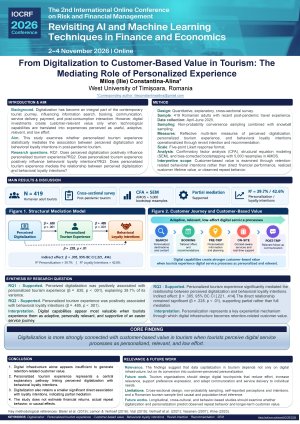
Introduction: Digital investments in tourism create economic value only when they translate into customer-relevant outcomes. This study examines whether personalized tourism experience statistically mediates the association between perceived digitalization and behavioral loyalty intentions, conceptualized as retention-related indicators rather than direct measures of financial performance.
Methods: A cross-sectional survey was conducted with 419 Romanian adults who had recent post-pandemic travel experience. Participants were recruited through convenience and snowball sampling. Perceived digitalization, personalized tourism experience, and revisit intention and recommendation behavior were modeled as reflective latent constructs. Confirmatory factor analysis, structural equation modeling, and bias-corrected bootstrapping with 5,000 resamples were performed in AMOS.
Results: Perceived digitalization was positively associated with personalized tourism experience (β = 0.630, p < 0.001), which was positively associated with behavioral loyalty intentions (β = 0.485, p < 0.001). The conditional direct association between perceived digitalization and loyalty intentions remained significant (β = 0.228, p < 0.001). The standardized indirect effect was β = 0.305, 95% BC CI [0.221, 0.414], supporting partial mediation. The model explained 39.7% of the variance in personalization and 42.6% of the variance in loyalty intentions.
Conclusions: The findings indicate that digitalization is more strongly connected with customer-based value when tourists experience digital service processes as adaptive, relevant, and low effort. From a data-capitalization perspective, digital infrastructure alone appears insufficient; its retention-related value emerges through customer-perceived personalization across service touchpoints. The study does not estimate financial returns, actual repeat behavior, or causal effects.
Keywords
perceived digitalization; personalized tourism experience; customer-based value; behavioral loyalty intentions; structural equation modeling; tourism services
Poster
Poster_IOCRF2026_Milos.I.C.-A.pdf
Analysis of the impact of revenue structure on Amazon platform share prices
Valuation Governance in Data-Constrained Markets: Integrating Valuation Uncertainty into Credit Risk Analytics via an Institutional Transmission Mechanism