Event submissions
Published
This submission belongs to the session S4. Data Capitalization: Reconstructing Economic Valuation of the event The 2nd International Online Conference on Risk and Financial Management
Published date
28 Oct, 2026
Academic Editor
 Sisira Colombage
Contribution&Funding
Conceptualization,
[Monodeep Saha]
Methodology,
[Monodeep Saha]
Software,
[Monodeep Saha]
Formal analysis,
[Monodeep Saha]
Data curation,
[Monodeep Saha]
Writing - original draft,
[Monodeep Saha]
Writing - review,
[editing] ; [Monodeep Saha]
Funding: --
Citation
Monodeep Saha, Valuation Governance in Data-Constrained Markets: Integrating Valuation Uncertainty into Credit Risk Analytics via an Institutional Transmission Mechanism, in Proceedings of The 2nd International Online Conference on Risk and Financial Management, 2 November–4 November 2026, MDPI: Basel, Switzerland
Share
Email
Facebook
Twitter
LinkedIn
Valuation Governance in Data-Constrained Markets: Integrating Valuation Uncertainty into Credit Risk Analytics via an Institutional Transmission Mechanism

Monodeep Saha 1
1. Management , European Global Institute of Innovation and Technology , St. Julians, 3154, Malta
Abstract
Automated valuation models (AVMs) are widely used in property-backed lending to support collateral valuation and credit risk assessment (Crosby, 2000; International Valuation Standards Council (IVSC), 2020). While prior research has examined AVM accuracy, bias and predictive performance, less attention has been paid to how valuation uncertainty generated by AVMs is incorporated into institutional credit risk decisions (French and Gabrielli, 2018).
I am proposing via this paper a conceptual framework positioning valuation governance as the institutional transmission mechanism linking AVM outputs to downstream credit risk analytics, including loan-to-value (LTV) calibration, loss given default (LGD) assumptions and expected credit loss (ECL) estimation (Basel Committee on Banking Supervision, 2017; European Banking Authority (EBA), 2017).
This framework is explicitly situated at the domain level of governance within credit processes. It therefore does not attempt to diagnose macroeconomic regime shifts or enterprise-level capital strategy decisions. Domain-level governance may, however, generate signals or escalation findings that inform enterprise-level deliberations where appropriate and, it explains how valuation governance disciplines the application of collateral values in lending decisions and defines escalation pathways where valuation uncertainty exceeds defined tolerance thresholds.
The framework further suggests that the intensity of valuation governance increases in conditions characterised by market illiquidity, asset heterogeneity, or elevated valuation frequency relative to observable transaction evidence, where the signal-to-noise ratio in automated estimates is likely to deteriorate (French and Gabrielli, 2018; International Valuation Standards Council (IVSC), 2020; Basel Committee on Banking Supervision, 2017).
Keywords
Automated Valuation Models (AVMs), Valuation Governance, Credit Risk Analytics, Loan-to-Value (LTV), Property-Backed Lending, Data-Constrained Markets
Keywords
Automated Valuation Models(AVMs)
Valuation Governance
Credit Risk Analytics
Loan-to-Value(LTV)
Property -Backed Lending
Data-Constrained Markets
Poster
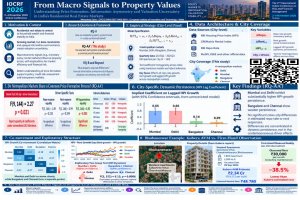
IOCRF2026_Housing_Price_Dynamics.pdf
From Digitalization to Customer-Based Value in Tourism: The Mediating Role of Personalized Experience
From Explainability to Accountability: The FinTRACE-AI Framework for Algorithmic Risk Governance in FinTech