Event submissions
Published
This submission belongs to the session S5. Ethical AI and Financial Technology Governance of the event The 2nd International Online Conference on Risk and Financial Management
Published date
28 Oct, 2026
Academic Editor
 Xianrong Shawn Zheng
Citation
Mahabbat Seyidova, THE ETHICAL CONSIDERATIONS OF AI, in Proceedings of The 2nd International Online Conference on Risk and Financial Management, 2 November–4 November 2026, MDPI: Basel, Switzerland
Share
Email
Facebook
Twitter
LinkedIn
THE ETHICAL CONSIDERATIONS OF AI

Mahabbat Seyidova 1
1. Department of International Relations, Faculty of International Relations and Economics, Baku State University, Baku, Azerbaijan.
Abstract
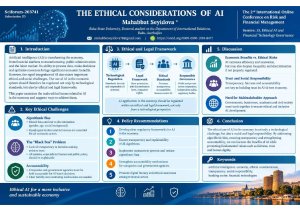
Artificial intelligence (AI) is applied across a wide spectrum of the economy, from financial markets to the manufacturing sector, from public administration to the labor market. While its decision-making speed, accuracy, and resource optimization capabilities create significant advantages, ethical issues and social risks also arise. For this reason, the application of AI in the economic sphere should be regulated not only within a technological, but also within an ethical and legal framework. In modern times, artificial intelligence (AI) technologies have begun to be widely applied in various sectors of the economy - financial markets, production processes, public administration and the labor market. The article argues that this process, while increasing economic efficiency, also raises serious ethical and social problems.
The use of AI in economics can sometimes lead to biased results. For example, algorithms used in credit risk assessment may be based on biased data, which can lead to discrimination in terms of gender, age and social background. This article analyses the ethical approach, according to which all economic actors should have equal opportunities and algorithmic biases should be minimized.
The article argues also the “black box” problem – the lack of understanding of the decision-making mechanisms of AI systems can reduce the trust of economic actors. The “black box” phenomenon – that is, the acceptance of the decision-making mechanisms of AI systems without explanation – is a serious risk for economic actors. Algorithms used in financial markets, government fiscal policy, or insurance systems should be explainable, and companies should be held accountable for the consequences of their decisions. Accountability mechanisms – companies and government agencies should be held accountable for the economic consequences of AI-based decisions.
Keywords
ethical considerations
economy
transparency
social responsibility
banking sector
financial technologies
artificial intelligence
Poster
Poster_sciforum.pdf
Impact of Governance on Digital Gold Platforms in South Asia
When AI Is the Story: LLM-Based Evidence on AI Narratives, Disclosure Credibility, and IPO Performance