Event submissions
Published
This submission belongs to the session S5. Ethical AI and Financial Technology Governance of the event The 2nd International Online Conference on Risk and Financial Management
Published date
28 Oct, 2026
Academic Editor
 Xianrong Shawn Zheng
Contribution&Funding
Conceptualization,
[jinyao huang]
Methodology,
[jinyao huang]
Software,
[Zhihui Liu]
Validation,
[jinyao huang]
Formal analysis,
[jinyao huang]
Project administration,
[Zhihui Liu]
Funding: --
Citation
jinyao huang, Zhihui Liu, FA-HGNN: A Fairness-Aware Heterogeneous Graph Neural Network for Credit Risk Control in Small and Micro Enterprises, in Proceedings of The 2nd International Online Conference on Risk and Financial Management, 2 November–4 November 2026, MDPI: Basel, Switzerland
Share
Email
Facebook
Twitter
LinkedIn
FA-HGNN: A Fairness-Aware Heterogeneous Graph Neural Network for Credit Risk Control in Small and Micro Enterprises

jinyao huang 1
Zhihui Liu 2
1. Quantitative Finance and FinTech, Hong Kong Polytechnic University, Hong Kong, Hong Kong
2. ChangjiangLab, Hunan Frontier Interdisciplinary Information Technology Research Institute Ltd., Changsha, China
Abstract
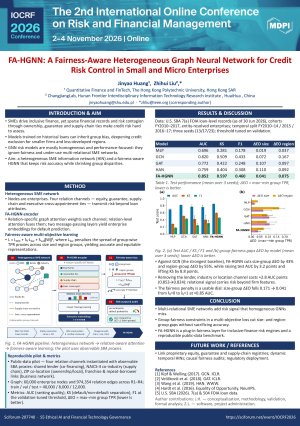
Small and micro enterprises are the main players in inclusive finance, but their credit risk management has long faced real challenges like sparse data and complex risk transmission relationships. Traditional AI risk control models rely on historical data for training, which can easily reinforce group biases and worsen credit exclusion, making it hard to meet both risk detection accuracy and lending fairness. Existing research on graph neural network (GNN) risk control mostly focuses on improving model performance, paying little attention to algorithm fairness, and hasn't fully tapped into the risk transmission value of diverse connections between small and micro enterprises, such as equity, guarantees, and supply chains.
This paper builds a heterogeneous information network for small and micro enterprises that integrates equity ties, guarantee relationships, supply chain transactions, and executive cross-appointments. It proposes a fairness-aware heterogeneous graph neural network risk control model (FA-HGNN): it uses a heterogeneous graph attention mechanism to measure the risk transmission strength of different relationship types differently, while embedding group fairness constraints into a multi-objective loss function to calibrate credit biases across different groups during model training.
Empirical results based on publicly available US SBA small business lending datasets show that, compared with baseline models like GCN, GAT, and HAN, our model significantly reduces fairness biases across enterprise size and region while maintaining competitive core risk control metrics like AUC, KS, and F1. This achieves an effective balance between risk prevention efficiency and fair lending services, offering a practical technical approach and empirical support for the digital transformation of inclusive finance.
Keywords
Heterogeneous graph neural networks; credit risk assessment; algorithmic fairness; small and micro enterprises; multi-objective optimization
Poster
FA-HGNN_poster.pdf
Modeling Agentic Crime: A Proposed ROSI Framework for Deepfake and AI-Enabled Financial Risk
Ethical Governance of Artificial Intelligence and Its Impact on the Efficiency of Zakat Collection: An Empirical Study