Event submissions
Published
This submission belongs to the session S6. Emerging Tech Convergence: Future Financial Infrastructure of the event The 2nd International Online Conference on Risk and Financial Management
Published date
28 Oct, 2026
Academic Editor
 Ramona Rupeika-Apoga
Citation
Nelvi Sutanto, Sustainable Future Fnancial Infrastructure: Empowering Micro, Small, and Medium Enterprises (MSMEs), in Proceedings of The 2nd International Online Conference on Risk and Financial Management, 2 November–4 November 2026, MDPI: Basel, Switzerland
Share
Email
Facebook
Twitter
LinkedIn
Sustainable Future Fnancial Infrastructure: Empowering Micro, Small, and Medium Enterprises (MSMEs)

Nelvi Sutanto 1
1. Online E-learning Business Campus, St. Peter College, Medan, Indonesia
Abstract
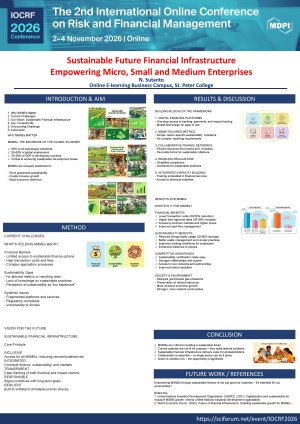
Micro, Small, and Medium Enterprises ( MSMEs) constitute over 90% of global businesses, employ half the world's workforce, and drive significant economic growth - yet they remain underserved by financial systems designed for larger corporations. As the global community confronts interconnected challenges of inequality, and economic resilience, MSMEs are both critical to delivering sustainable development and uniquely vulnerable to unsustainable practices. This paper presents a comprehensive framework for sustainable future financial infrastructure tailored to empower MSMEs, integrating environmental stewardship, social equity, and economic viability into core system design.
Drawing on case study from emerging and developed economies, the research analyzes current barriers including limited access to sustainable finance, high transaction costs, lack of tailored tools, and fragmented systems. It proposes five interconnected components: digital enabling platforms, simplified sustainability metrics for small businesses, collaborative finance networks, supportive regulatory frameworks, and integrated capacity building. The analysis demonstrates that such infrastructure not only addresses MSME needs but also creates value for financial institutions, and society at large.
The paper concludes that transitioning to sustainable financial infrastructure for MSMEs requires cross-sector collaboration, targeted investment in pilot initiatives, and policy reforms that align financial incentives with long term sustainability goals. By centering MSMEs in the design of future financial systems, hopefully we can build an inclusive, resilient economy that advances both business prosperity and well being.
Keywords
Micro
Small and Medium Enterprises (MSMEs)
Sustainable Financial
Poster
IOCRF 2026-Nelvi-rev.pdf
"Strategic Funding Models for Financial Sustainability of Private Universities in India: A Systematic Review"
Issuance Design and Benchmark Accumulation in Sovereign Green Bond Markets: Evidence from Canada