Event submissions
Published
This submission belongs to the session S6. Emerging Tech Convergence: Future Financial Infrastructure of the event The 2nd International Online Conference on Risk and Financial Management
Published date
28 Oct, 2026
Academic Editor
 Ramona Rupeika-Apoga
Citation
Piotr Pach, Issuance Design and Benchmark Accumulation in Sovereign Green Bond Markets: Evidence from Canada, in Proceedings of The 2nd International Online Conference on Risk and Financial Management, 2 November–4 November 2026, MDPI: Basel, Switzerland
Share
Email
Facebook
Twitter
LinkedIn
Issuance Design and Benchmark Accumulation in Sovereign Green Bond Markets: Evidence from Canada
Issuance Design and Benchmark Accumulation in Sovereign Green Bond Markets: Evidence from Canada

Piotr Pach 1
1. Department of Business and Management, Roskilde University, Universitetsvej 1, Roskilde 4000, Denmark
Abstract
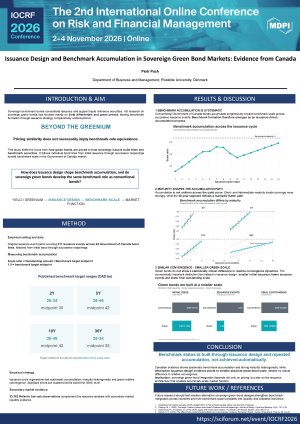
This paper examines how legally and credit-equivalent sovereign bonds can develop different benchmark roles within the same government bond market. Existing research on sovereign green bonds mainly focuses on yield differentials and green premia, but pricing equivalence does not necessarily imply benchmark-role equivalence. Using the Canadian sovereign bond market as the empirical setting, this study analyses benchmark formation as an observable issuance-based accumulation process. The analysis uses bond-level issuance-event data and compares outstanding amounts with published benchmark target ranges across maturity segments. The results show that conventional Government of Canada bonds systematically accumulate toward benchmark scale, with clear heterogeneity across maturity buckets. Green and conventional bonds do not show statistically robust differences in relative convergence dynamics, but descriptive issuance-design evidence suggests that green bonds remain smaller in absolute scale, with lower initial issue sizes, fewer reopenings, and lower final outstanding amounts. The Danish twin-bond framework is used as an institutional contrast, showing how green bond integration can be supported by design when financial characteristics and liquidity access are aligned. The findings suggest that sovereign green bond market integration depends not only on investor demand or pricing, but also on issuance strategy, reopening intensity, and benchmark-scale accumulation. The paper contributes to sovereign debt management and sustainable finance by showing that green bond programmes should be evaluated not only through greenium evidence, but also through their ability to build benchmark market function.
Keywords
sovereign green bonds
benchmark formation
issuance design
sovereign debt management
market liquidity
Poster
Piotr_Pach_IOCRF2026_Poster.pdf
Sustainable Future Fnancial Infrastructure: Empowering Micro, Small, and Medium Enterprises (MSMEs)
Leapfroggning Legacy Finance: Fintech Infrastructure Transformation in Central Asia (Evidence from Uzbekistan and Kazakhstan)