Event submissions
Published
This submission belongs to the session S6. Emerging Tech Convergence: Future Financial Infrastructure of the event The 2nd International Online Conference on Risk and Financial Management
Published date
28 Oct, 2026
Academic Editor
 Ramona Rupeika-Apoga
Citation
Tamar Gugushvili, Medea Gugushvili, TAP-i: A Prototype Platform for AI-Assisted Bank Guarantee Processing in Emerging Markets, in Proceedings of The 2nd International Online Conference on Risk and Financial Management, 2 November–4 November 2026, MDPI: Basel, Switzerland
Share
Email
Facebook
Twitter
LinkedIn
TAP-i: A Prototype Platform for AI-Assisted Bank Guarantee Processing in Emerging Markets

Tamar Gugushvili 1
Medea Gugushvili 2
1. Faculty of Business Technologies, Georgian Technical University, Tbilisi, 0160, Georgia
2. Independent Researcher, Tbilisi, 0160, Georgia
Abstract
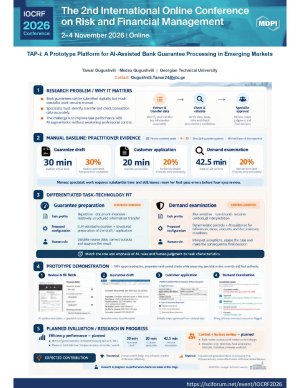
Bank guarantee processing in emerging markets remains a document-intensive and largely manual workflow, relying on source documents, internal templates, standard clauses, and specialist judgment. This creates operational inefficiencies, duplicate data entry, and risks of inconsistency or human error. In smaller and highly competitive financial markets, service quality and response speed are critical differentiators.
Drawing on business process reengineering processing, this study positions TAP-i as a prototype-based conceptual model for redesigning document-intensive bank guarantee workflows through structured data capture, reusable templates, rule-based validation, AI-assisted drafting, and human-in-the-loop control. The platform concept is based on a practice-based analysis of guarantee workflows, recurring guarantee types, standard data fields, and validation requirements. TAP-i is designed to allow users to select the relevant guarantee type and choose between paper-format wording and SWIFT-based guarantee preparation.
The prototype demonstrates how selected steps in bank guarantee processing could be supported through AI-assisted and rule-based functionality. TAP-i is intended to extract information from source documents, such as pro-forma invoices or contracts, generate draft guarantee wording, and present the output for maker validation. Once confirmed, it would automatically generate the customer application together with the guarantee text. The platform is also intended to support amendment generation and assist in reviewing demands received under guarantees by checking formal requirements, deadlines, guarantee references, claimed amounts, and consistency with guarantee terms.
The study contributes to the discussion on digital transformation in trade finance by showing how business process reengineering, intelligent document extraction, and human-in-the-loop can be combined in a controlled guarantee-processing workflow. Although focused on bank guarantees, TAP-i provides a foundation for future extension to documentary credits and other trade finance instruments. For emerging-market banks, the prototype offers a lightweight and adaptable model for improving efficiency, auditability, service speed, and client relationship management.
Keywords
Trade finance
bank guarantees
artificial intelligence
business process reengineering
human-in-the-loop
emerging markets.
Poster
Poster Gugushvili.pdf
Leapfroggning Legacy Finance: Fintech Infrastructure Transformation in Central Asia (Evidence from Uzbekistan and Kazakhstan)
Mobile Financial Service: Enhancing the Inclusion for the Informal Workers in Dhaka, Bangladesh