Event submissions
EventsThe 2nd International Electronic Conference on Medicinal Chemistry and Pharmaceutics
Published
This submission belongs to the session S2. General of the event The 2nd International Electronic Conference on Medicinal Chemistry and Pharmaceutics
Published date
28 Oct, 2026
Academic Editor
 Alfredo Berzal-Herranz
Contribution&Funding
Conceptualization,
[Johanna Marie Fellhölter]
Methodology,
[Johanna Marie Fellhölter] ; [Sandra Jordan] ; [Christian Werner] ; [Alexander Gast]
Formal analysis,
[Johanna Marie Fellhölter] ; [Christian Werner] ; [Alexander Gast]
Investigation,
[Johanna Marie Fellhölter] ; [Sandra Jordan] ; [Christian Werner]
Writing - original draft,
[Johanna Marie Fellhölter] ; [Christian Werner]
Funding: --
Citation
Johanna Marie Fellhölter, Sandra Jordan, Christian Werner, Alexander Gast, Karsten Niefind, Joachim Jose, Impact of Poirier-Bienvenu Neurodevelopmental Disease-associated Variants on CK2 Holoenzyme Assembly, in Proceedings of The 2nd International Electronic Conference on Medicinal Chemistry and Pharmaceutics, 1 November–30 November 2026, MDPI: Basel, Switzerland
Share
Email
Facebook
Twitter
LinkedIn
Impact of Poirier-Bienvenu Neurodevelopmental Disease-associated Variants on CK2 Holoenzyme Assembly

Johanna Marie Fellhölter 1
Sandra Jordan 2
Christian Werner 2
Alexander Gast 1

Karsten Niefind 2

Joachim Jose 1
1. Institut for Pharmaceutical and Medicinal Chemistry, University of Münster, Münster, 48149, Germany
2. Institute for Biochemistry, Universität zu Köln, Cologne, 50674 , Germany
Abstract
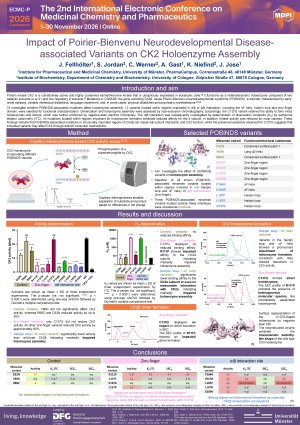
Protein kinase CK2 is a constitutively active and highly conserved serine/threonine kinase that is ubiquitously expressed in eukaryotic cells.[1] It functions as a heterotetrameric holoenzyme composed of two catalytic subunits (α or α′) and two regulatory β subunits.[2] Mutations in CSNK2B, the gene encoding CK2β, cause Poirier-Bienvenu neurodevelopmental syndrome (POBINDS), a disorder characterized by early-onset epilepsy, variable intellectual disability, language impairment, and, in some cases, physical disabilities and psychiatric manifestations.[3] [4]
To investigate whether POBINDS-associated mutations affect holoenzyme assembly 12 variants located within regions implicated in α/β or β/β interaction, including the αF helix, hairpin loop and zinc finger domain, were selected for functional characterization. All variants located within regions important for holoenzyme formation exhibited reduced affinity for the α subunit. In addition, kinase activity was reduced for most variants. The α/β interaction was subsequently investigated by determination of dissociation constants (KD). Dimerization and holoenzyme assembly were assessed by size-exclusion chromatography. Surprisingly, the C137G variant retained the ability to form intact holoenzymes and dimers, which was further confirmed by negative-stain electron microscopy. These findings indicate that POBINDS-associated mutations in structurally important regions of CK2β can impair α/β subunit interaction and CK2 function, while the preserved assembly observed for C137G suggests that individual variants may affect CK2 through distinct molecular mechanisms.
[1] D. W. Litchfield, G. Dobrowolska et al., Biochem. J., 2003, 369, 1–15.
[2] K. Niefind, J. Raaf et al., Cell. Mol. Life Sci., 2009, 66, 1800–1816.
[3] W. Zhang, F. Ye et al., Front. Neurosci., 2022, 16, 892768.
[4] A. Orsini, A. Santangelo et al., Genes, 2022, 13, 276.
Keywords
CK2
POBINDS
CSNK2B
Holoenzyme
Neurodevelopmental disease
Capillary electrophoresis
Binding affinity
KD
Subunit interaction
size-exclusion chromatography
Poster
Poster_ECMC.pdf
Electrochemical evaluation of the antioxidant capacity of medicinal plant micellar extracts