Event submissions
EventsThe 2nd International Electronic Conference on Medicinal Chemistry and Pharmaceutics
Published
This submission belongs to the session S2. General of the event The 2nd International Electronic Conference on Medicinal Chemistry and Pharmaceutics
Published date
28 Oct, 2026
Academic Editor
 Francisco Javier Otero Espinar
Contribution&Funding
Conceptualization,
[Guzel Ziyatdinova]
Methodology,
[Guzel Ziyatdinova]
Validation,
[Guzel Ziyatdinova] ; [Elizaveta Krasilni'kova]
Investigation,
[Elizaveta Krasilni'kova]
Writing - original draft,
[Guzel Ziyatdinova]
Writing - review,
[editing] ; [Guzel Ziyatdinova]
Visualization,
[Guzel Ziyatdinova] ; [Elizaveta Krasilni'kova]
Supervision,
[Guzel Ziyatdinova]
Funding: --
Citation
Guzel Ziyatdinova, Elizaveta Krasilni'kova, Electrochemical evaluation of the antioxidant capacity of medicinal plant micellar extracts, in Proceedings of The 2nd International Electronic Conference on Medicinal Chemistry and Pharmaceutics, 1 November–30 November 2026, MDPI: Basel, Switzerland
Share
Email
Facebook
Twitter
LinkedIn
Electrochemical evaluation of the antioxidant capacity of medicinal plant micellar extracts

Guzel Ziyatdinova 1

Elizaveta Krasilni'kova 1
1. Analytical Chemistry Department, Kazan Federal University, Kazan, Russia
Abstract
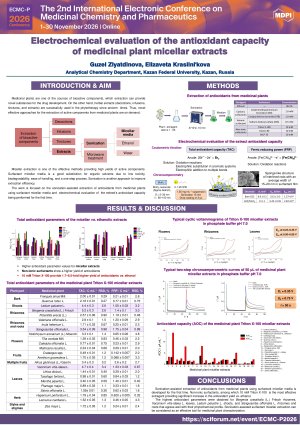
Medicinal plants are one of the sources of bioactive components, which extraction can provide novel substances for the drug development. The use of sonication-assisted extraction of antioxidants from medicinal plants using surfactant micellar media is developed for the first time. The surfactant nature (cationic, non-ionic, and anionic) effect was tested, and the data obtained were compared to traditional ethanolic extracts. Non-ionic surfactants are the most effective. According to coulometric titration with electrogenerated titrants (bromine and hexacyanoferrate(III) ions), Triton X-100 (10 mM) is the best extractant providing 1.7–6.5-fold higher yield of antioxidants vs. ethanol. The obtained total antioxidant capacity and ferric reducing power of the extracts indicate total content of the antioxidants of various classes and the total content of phenolic antioxidants in the sample, respectively. A two-step chronoamperometric method at the electrode modified with MnO2 nanorods was developed for antioxidant capacity evaluation of the medicinal plant micellar extracts. The electrode was characterized by scanning electron microscopy, electrochemical impedance spectroscopy, and voltammetry. A two-step chronoamperometry at 0.35 and 0.75 V for 50 s each allows assessment of the contribution from the antioxidants of different powers to the antioxidant capacity of the samples. Electrochemical approaches were used for screening of 24 samples of commercial medicinal plants of various species used in phytotherapy. The plant parts included bark, shoots, rhizomes and roots, leaves, herb, flowers, fruits, etc. The highest antioxidant parameters were obtained for Bergenia crassifolia (L.) Fritsch rhizomes, Vaccinium vitis-idaea L. leaves, Ledum palustre L. shoots, and Sanguisorba officinalis L. rhizomes and roots that agrees well with their phytochemical profile.
Keywords
Coulometric titration
chronoamperometry
micellar extraction
sonication
medicinal plants
antioxidants
Poster
Poster.pdf
Impact of Poirier-Bienvenu Neurodevelopmental Disease-associated Variants on CK2 Holoenzyme Assembly
Synthesis of a Trifluoromethyl-Substituted Thiophene Chalcone: A Spectroscopic Study