Event submissions
EventsThe 2nd International Electronic Conference on Medicinal Chemistry and Pharmaceutics
Published
This submission belongs to the session S2. General of the event The 2nd International Electronic Conference on Medicinal Chemistry and Pharmaceutics
Published date
28 Oct, 2026
Academic Editor
 Mary J. Meegan
Contribution&Funding
Validation,
[Sofia Shtykalova]
Investigation,
[Sofia Shtykalova]
Data curation,
[Sofia Shtykalova]
Writing - original draft,
[Sofia Shtykalova]
Funding: The study is supported by Ministry of Higher Education and Science of Russian Federation (project 1024032800068-4-3.2.2).
Citation
Sofia Shtykalova, Anna Egorova, Natalia Shved, Anton Kiselev, Epigenetic regulation as a new approach to gene therapy of uterine leiomyoma, in Proceedings of The 2nd International Electronic Conference on Medicinal Chemistry and Pharmaceutics, 1 November–30 November 2026, MDPI: Basel, Switzerland
Share
Email
Facebook
Twitter
LinkedIn
Epigenetic regulation as a new approach to gene therapy of uterine leiomyoma

Sofia Shtykalova 1
Anna Egorova 1
Natalia Shved 1

Anton Kiselev 1
1. Department of Genomic Medicine named after V.S. Baranov, D.O. Ott Research Institute of Obstetrics, Gynecology and Reproductology, Saint-Petersburg, 199034, Russia
Abstract
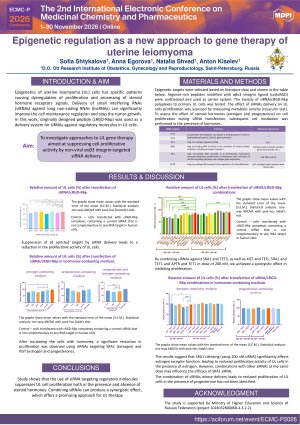
Introduction. Epigenetics of uterine leiomyoma (UL) cells has specific patterns causing dysregulation of proliferation and processing of steroid hormone receptors signals. Delivery of small interfering RNAs (siRNAs) against long non-coding RNAs (lncRNAs) can significantly improve the cell maintenance regulation and stop the tumor growth. In this work, originally designed peptide (cRGD-R6p) was used as a delivery system for siRNAs against regulatory molecules in UL cells.
Methods. Epigenetic targets (TET3, TET1, H19, SRA1, XIST, APTR) were selected based on literature data. Arginine-rich peptides modified with αβν3 integrin ligand (cycloRGD) were synthesized and used as carrier system. The toxicity of siRNA/cRGD-R6p polyplexes to primary UL cells was tested. The effect of siRNAs delivery on UL cells proliferation was assessed by measuring metabolic activity (resazurin test). To assess the effect of steroid hormones (estrogen and progesterone) on cell proliferation during siRNA transfection, subsequent cell incubation was performed in the presence of hormones.
Results. Delivery of each selected siRNA resulted in a statistically significant decrease in UL cell proliferation. After incubating the cells with hormones, a significant reduction in proliferation was observed using siRNAs targeting SRA1 (estrogen) and XIST (estrogen and progesterone). By combining siRNAs against SRA1 and TET3, we achieved a synergistic effect in inhibiting proliferation.
Conclusion. Study shows that the use of siRNA targeting regulatory molecules suppresses UL cell proliferation both in the presence and absence of steroid hormones. Combining siRNAs can produce a synergistic effect, which offers a promising approach for UL therapy.
Keywords
uterine leiomyoma
epigenetics
RNA interference
non-viral carriers
peptide carriers
Poster
poster ECMC Shtykalova.pdf
Design of a Dual Adjuvant Multi-epitope Vaccine Candidate against Helicobacter pylori
An integrated in silico and bioactivity-based assessment of the potential thyroid-disrupting activity of UV filters