Event submissions
EventsThe 2nd International Electronic Conference on Medicinal Chemistry and Pharmaceutics
Published
This submission belongs to the session S2. General of the event The 2nd International Electronic Conference on Medicinal Chemistry and Pharmaceutics
Published date
28 Oct, 2026
Academic Editor
 Mary J. Meegan
Contribution&Funding
Conceptualization,
[Montserrat Mitjans]
Methodology,
[Montserrat Mitjans] ; [Elisabet Teixidó] ; [Laia Guardia-Escote] ; [Adriana Solange Maddaleno]
Software,
[Elisabet Teixidó]
Validation,
[Laia Guardia-Escote] ; [Montserrat Mitjans] ; [Adriana Solange Maddaleno] ; [Elisabet Teixidó]
Formal analysis,
[Adriana Solange Maddaleno] ; [Montserrat Mitjans] ; [Elisabet Teixidó] ; [Laia Guardia-Escote]
Resources,
[Montserrat Mitjans]
Data curation,
[Montserrat Mitjans] ; [Laia Guardia-Escote] ; [Elisabet Teixidó]
Writing - original draft,
[Montserrat Mitjans]
Writing - review,
[editing] ; [Laia Guardia-Escote] ; [Elisabet Teixidó] ; [Adriana Solange Maddaleno] ; [Montserrat Mitjans]
Visualization,
[Elisabet Teixidó] ; [Adriana Solange Maddaleno]
Supervision,
[Montserrat Mitjans]
Project administration,
[Montserrat Mitjans] ; [Elisabet Teixidó]
Funding acquisition,
[Elisabet Teixidó] ; [Montserrat Mitjans]
Funding: --
Citation
Elisabet Teixidó, Adriana Solange Maddaleno, Laia Guardia-Escote, Montserrat Mitjans, An integrated in silico and bioactivity-based assessment of the potential thyroid-disrupting activity of UV filters, in Proceedings of The 2nd International Electronic Conference on Medicinal Chemistry and Pharmaceutics, 1 November–30 November 2026, MDPI: Basel, Switzerland
Share
Email
Facebook
Twitter
LinkedIn
An integrated in silico and bioactivity-based assessment of the potential thyroid-disrupting activity of UV filters

Elisabet Teixidó 1,2

Adriana Solange Maddaleno 3

Laia Guardia-Escote 1,2
Montserrat Mitjans 3
1. GRET - Department of Pharmacology, Toxicology and Therapeutic Chemistry, Faculty of Pharmacy and Food Sciences, University of Barcelona, Barcelona, 08028, Spain
2. INSA, Institut de Nutrició i Seguretat Alimentaria, University of Barcelona, Barcelona, 08028, Spain
3. CEREX - Department of Biochemistry and Physiology, Faculty of Pharmacy and Food Sciences, University of Barcelona, Barcelona, 08028, Spain
Abstract
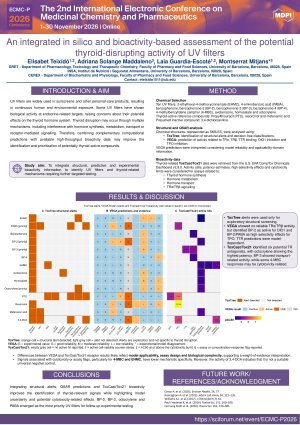
The identification of potential endocrine-disrupting chemicals requires integrated approaches combining structural information, existing biological evidence, and targeted experimental testing. ToxTree, VEGA and thyroid-related ToxCast/ToxCast21 bioactivity data were used as complementary first-line in silico tools to evaluate ten selected UV filters: 2-ethylhexyl-4-methoxycinnamate (EHMC), 4-eminobenzoic acid (PABA), benzophenone, benzophenone-2 (BP-2), benzophenone-3 (BP-3), bezophenone-4 (BP-4), 4-methylbenzylidene camphor (4-MBC), avobenzone, homosalate and octocrylene. Propylthiouracil (PTU), resorcinol, and mefenamic acid were included as reference compounds with documented effects on thyroid-related processes, whereas 3,4-dichloroaniline was included as a presumed negative compound. ToxTree identified several not specific structural alerts in both the reference chemicals and the UV filters. VEGA did not identify reliable activity of any UV filter in the TRα or TRβ models while ToxCast/Tox21 data indicated potential TRα/TRβ antagonist activity for six UV filters, being octocrylene the most active. The strongest findings were obtained for BP-2, for which experimental data indicated DIO1 activity and a high-selectivity effect (HSE) on TPO, and for PABA, which was also experimentally classified as HSE for TPO. TTR-binding predictions were model-dependent: BP-3, avobenzone, and homosalate were predicted to be active with good reliability by the ONTOX model but inactive by the ED-Screen TTR model. Moreover, 3,4-DCA was classified as HSE for TPO with moderate reliability and associated with cytotoxicity according to ToxCast/Tox21, indicating that it should not be considered a universal negative control. Conversely, the ToxCast/Tox21 receptor signals were not corroborated by reliable VEGA TR predictions. Based on the combined bioactivity profiles, BP-2, BP-3, octocrylene and PABA emerged as the most priority UV filters for follow-up experimental testing.
Keywords
in silico
UV filters
Thyroid disruption
ToxCast/Tox21
chemical prioritization
Poster
ECMC_2026_UVfilters.pdf
Epigenetic regulation as a new approach to gene therapy of uterine leiomyoma
Effect of Myelopeptide 2 on Addiction Memory in the Mouse