Event submissions
EventsThe 2nd International Electronic Conference on Medicinal Chemistry and Pharmaceutics
Published
This submission belongs to the session S2. General of the event The 2nd International Electronic Conference on Medicinal Chemistry and Pharmaceutics
Published date
28 Oct, 2026
Academic Editor
 Mary J. Meegan
Contribution&Funding
Writing - original draft,
[Gleb Volcho]
Writing - review,
[editing] ; [Nicolay Beregovoy]
Funding: --
Citation
Gleb Volcho, Nicolay Beregovoy, Effect of Myelopeptide 2 on Addiction Memory in the Mouse, in Proceedings of The 2nd International Electronic Conference on Medicinal Chemistry and Pharmaceutics, 1 November–30 November 2026, MDPI: Basel, Switzerland
Share
Email
Facebook
Twitter
LinkedIn
Effect of Myelopeptide 2 on Addiction Memory in the Mouse

Gleb Volcho 1
Nicolay Beregovoy 1
1. laboratory of addiction, Federal Research Center for Fundamental and Translational Medicine, Novosibirsk, 630117, Russia
Abstract
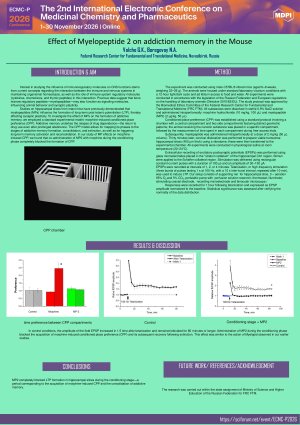
As is known, myelopeptides (MPs) influence the formation of long-term post-tetanic potentiation (LTP)—that is, they affect synaptic plasticity. To investigate the effect of MPs on the formation of addictive memory, we employed a morphine-induced conditioned place preference (CPP).
The experiment was conducted on male C57BL/6 inbred mice. Morphine hydrochloride (10 mg/kg, 100 µL) and MP2 (2 µg/kg, 50 µL) were dissolved in sterile 0.9% NaCl and administered intraperitoneally. CPP was established using a standard protocol for morphinization. Extracellular recording of excitatory postsynaptic potentials (EPSPs) was performed using glass microelectrodes placed in the stratum radiatum of the hippocampal slices CA1 region. Stimuls were applied to the Schaffer collateral region.
In control conditions, the amplitude of the field EPSP increased in 1.5 time after tetanization and remained elevated for 60 minutes or longer. Administration of MP2 during the conditioning phase blocked the acquisition of the conditioned place preference response and its subsequent recovery following extinction. MP2 completely blocks the formation of LTP in experiments on animal hippocampal slices during the conditioning stage corresponding to the acquisition of the morphine-induced conditioned place preference and the consolidation of addictive memory. The research was carried out within the state assignment of Ministry of Science and Higher Education of the Russian Federation for FRC FTM.
Keywords
myelopeptides,
morphine
addiction
mice
hippocamp
Poster
Volcho.pdf
An integrated in silico and bioactivity-based assessment of the potential thyroid-disrupting activity of UV filters
Development and Characterization of a High-Fat High-Sucrose Dietary Model for Experimental Hepatic Injury in Wistar Rats