Event submissions
EventsThe 2nd International Electronic Conference on Medicinal Chemistry and Pharmaceutics
Published
This submission belongs to the session S2. General of the event The 2nd International Electronic Conference on Medicinal Chemistry and Pharmaceutics
Published date
28 Oct, 2026
Academic Editor
 Alfredo Berzal-Herranz
Contribution&Funding
Conceptualization,
[Montse Mitjans Arnal] ; [Maria Pilar Vinardell] ; [Adriana Solange Maddaleno]
Methodology,
[Adriana Solange Maddaleno]
Formal analysis,
[Montse Mitjans Arnal] ; [Adriana Solange Maddaleno]
Investigation,
[Adriana Solange Maddaleno]
Resources,
[Maria Pilar Vinardell]
Writing - original draft,
[Montse Mitjans Arnal] ; [Adriana Solange Maddaleno]
Writing - review,
[editing] ; [Montse Mitjans Arnal] ; [Maria Pilar Vinardell]
Funding: Grant PID2020-113186RB-I00 funded by MCIN/AEI/10.13039/501100011033
Citation
Montse Mitjans Arnal, Maria Pilar Vinardell, Adriana Solange Maddaleno, Comparing Balb/c 3T3, HaCaT and 1BR.3.G for in vitro phototoxicity assessment: a preliminary study, in Proceedings of The 2nd International Electronic Conference on Medicinal Chemistry and Pharmaceutics, 1 November–30 November 2026, MDPI: Basel, Switzerland
Share
Email
Facebook
Twitter
LinkedIn
Comparing Balb/c 3T3, HaCaT and 1BR.3.G for in vitro phototoxicity assessment: a preliminary study

Montse Mitjans Arnal 1

Maria Pilar Vinardell 1
Adriana Solange Maddaleno 1
1. Biochemistry and Physiology, Universitat de Barcelona, Barcelona, 08028, Spain
Abstract
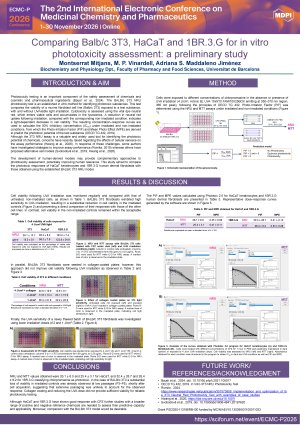
Phototoxicity testing is an important component of the safety assessment of chemicals and cosmetic and pharmaceutical ingredients. The BALB/c 3T3 NRU phototoxicity test is an established in vitro method for identifying phototoxic substances. The development of human-derived models may provide complementary and potentially more human-relevant approaches for phototoxicity assessment. This study aimed to compare the phototoxic responses of HaCaT and 1BR.3.G cells with the established cell model. Cells were exposed to different concentrations of chlorpromazine in the absence or presence of UVA irradiation (4 J/cm², Actinic BL UVA 15W/10 FAM/10X25BOX emitting at 350–370 nm region, 365 nm peak), following the principles of OECD TG 432. Photo-Irritation Factor (PIF) was determined using the NRU and MTT assays under irradiated and non-irradiated conditions. NRU and MTT values obtained were 26.1 ± 6.0 and 25.4 ± 3.1 for HaCaT, and 52.4 ± 28.7 and 28.4 ± 8.2 for 1BR.3.G classifying chlorpromazine as phototoxic. In the case of BALB/c 3T3 a substantial loss of viability in irradiated controls was already observed at low passages (P3–P5), shortly after cell acquisition, suggesting that extensive passaging was unlikely to account for the observed response. Collagen coating and reducing the UVA dose did not provide sufficient viability for reliable phototoxicity testing. Although HaCaT and 1BR.3.G have shown good response with CPZ further studies with a broader range of positive and negative reference chemicals are needed to assess their predictive capacity and applicability. Moreover, comparison with the BALB/c 3T3 model would be desirable.
Keywords
in vitro
NAMs
phototoxicity
cell assays
Poster
Mitjans_et_al_2026.pdf
PROOF-OF-CONCEPT EVALUATION OF THE DIFFUSE REFLECTANCE KINETIC METHOD FOR THE ANALYSIS OF BIOLOGICAL PREPARATIONS IN TURBID MEDIA
PepSMILES: SMILES Generator for Chemically Modified and Cyclized Peptides