Event submissions
EventsThe 2nd International Electronic Conference on Medicinal Chemistry and Pharmaceutics
Published
This submission belongs to the session S2. General of the event The 2nd International Electronic Conference on Medicinal Chemistry and Pharmaceutics
Published date
28 Oct, 2026
Academic Editor
 Alfredo Berzal-Herranz
Contribution&Funding
Methodology,
[Virginia Vetere] ; [Pedro Alfonso Colinas]
Investigation,
[Leonardo Ezequiel Riafrecha] ; [Virginia Vetere] ; [Pedro Alfonso Colinas]
Resources,
[Virginia Vetere] ; [Pedro Alfonso Colinas]
Writing - original draft,
[Leonardo Ezequiel Riafrecha]
Writing - review,
[editing] ; [Leonardo Ezequiel Riafrecha] ; [Pedro Alfonso Colinas]
Supervision,
[Virginia Vetere] ; [Pedro Alfonso Colinas]
Project administration,
[Pedro Alfonso Colinas]
Funding acquisition,
[Pedro Alfonso Colinas]
Funding: --
Citation
Ivana R. Vásquez, Leonardo Ezequiel Riafrecha, Virginia Vetere, Pedro Alfonso Colinas, Reduction of glycosylimines: Synthetic strategies and carbonic anhydrase inhibitory activity, in Proceedings of The 2nd International Electronic Conference on Medicinal Chemistry and Pharmaceutics, 1 November–30 November 2026, MDPI: Basel, Switzerland
Share
Email
Facebook
Twitter
LinkedIn
Reduction of glycosylimines: Synthetic strategies and carbonic anhydrase inhibitory activity

Ivana R. Vásquez 1,2
Leonardo Ezequiel Riafrecha 1
Virginia Vetere 2
Pedro Alfonso Colinas 1
1. GICAR-CEDECOR (UNLP-CICBA), CONICET, Department of Chemistry,Faculty of Exact Sciences, National University of La Plata, 47 and 115 (1900), La Plata, Buenos Aires, Argentina
2. CINDECA, CONICET,Department of Chemistry, Faculty of Exact Sciences, National University of La Plata, 47 and 115 (1900), La Plata, Buenos Aires, Argentina
Abstract
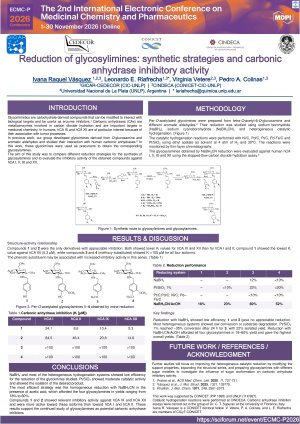
Glycomimetics have emerged as a class of compounds of significant pharmacological interest, as they have proven useful for the development of selective enzyme inhibitors. In our group, glycosylimines capable of selectively inhibiting carbonic anhydrase (CA) IX, an isoform overexpressed in tumor tissues, have been previously reported.1 Glycosylimines were obtained from D-glucosamine and substituted aromatic aldehydes under basic conditions. In this work, their two complementary reduction strategies, homogeneous and heterogeneous, were investigated and compared, followed by evaluation of the inhibitory activity of the resulting compounds against CA.
Homogeneous reduction with sodium cyanoborohydride (NaBH₃CN) in the presence of acetic acid (AcOH) afforded the corresponding glycosylamines in yields ranging from 18 to 60%, depending on the aromatic substituent. In contrast, sodium borohydride (NaBH₄) provided low yields (<15%) under the conditions evaluated.
Heterogeneous catalytic hydrogenation was also explored under mild conditions (30 °C, 4 atm H₂) using Ni/C, Pd/C, Pt/C, Pd-Fe/C, and Pt/SiO₂ catalysts. Most systems showed low activity or promoted substrate degradation. Among them, 1% Pt/SiO₂ achieved approximately 35% substrate conversion after 24h, although the desired product was isolated in low yield. These results indicate that the homogeneous reduction strategy was more efficient in terms of isolated yield.
The glycosylamines obtained by NaBH₃CN reduction were evaluated against human carbonic anhydrase isoforms I, II, IX, and XII. The p-hydroxybenzaldehyde derived and vanillin derived compounds showed inhibitory activity toward CA IX and CA XII, with Ki values ranging from 5.3 to 20.8 μM. These results support glycosylamine derivatives as promising scaffolds for the design of selective inhibitors targeting tumor-associated carbonic anhydrase isoforms.
1. Vásquez, I. R., Riafrecha, L. E., Martínez Heredia, L., Echeverría, G. A., Piro, O. E., Lavecchia, M. J., Supuran, C. T., & Colinas, P. A. (2025). Journal of Molecular Structure, 1321, 139778.
Keywords
Glycosylimines; Reduction; Carbonic Anhydrase; Enzyme Inhibitors
Poster
ECMC-P2026_Poster_Vasquez_Ivana.pdf
Enhanced skin delivery of triamcinolone acetonide using invasome-based formulations.
Concentration and time-dependent effects of Fe₃O₄ nanoparticles on acteoside and echinacoside production in Scrophularia striata Boiss. cell suspension cultures