Event submissions
EventsThe 2nd International Electronic Conference on Medicinal Chemistry and Pharmaceutics
Published
This submission belongs to the session S2. General of the event The 2nd International Electronic Conference on Medicinal Chemistry and Pharmaceutics
Published date
28 Oct, 2026
Academic Editor
 Alfredo Berzal-Herranz
Contribution&Funding
Conceptualization,
[Khadijeh Sabetpour] ; [Mohsen Sharifi]
Methodology,
[Khadijeh Sabetpour] ; [Reyhaneh Danaeipour]
Software,
[Khadijeh Sabetpour]
Validation,
[Mohsen Sharifi]
Formal analysis,
[Khadijeh Sabetpour]
Investigation,
[Khadijeh Sabetpour]
Resources,
[Khadijeh Sabetpour]
Writing - original draft,
[Khadijeh Sabetpour]
Writing - review,
[editing] ; [Mohsen Sharifi] ; [Vahid Niknam]
Funding: NO FUNDING
Citation
Khadijeh Sabetpour, Mohsen Sharifi, Vahid Niknam, Reyhaneh Danaeipour, Concentration and time-dependent effects of Fe₃O₄ nanoparticles on acteoside and echinacoside production in Scrophularia striata Boiss. cell suspension cultures
, in Proceedings of The 2nd International Electronic Conference on Medicinal Chemistry and Pharmaceutics, 1 November–30 November 2026, MDPI: Basel, Switzerland
Share
Email
Facebook
Twitter
LinkedIn
Concentration and time-dependent effects of Fe₃O₄ nanoparticles on acteoside and echinacoside production in Scrophularia striata Boiss. cell suspension cultures

Khadijeh Sabetpour 1
Mohsen Sharifi 1
Vahid Niknam 2
Reyhaneh Danaeipour 1
1. Department of Plant Biology, Faculty of Biological Sciences, Tarbiat Modares University, Tehran, Iran
2. School of Biology, College of Science, University of Tehran, Tehran, Iran
Abstract
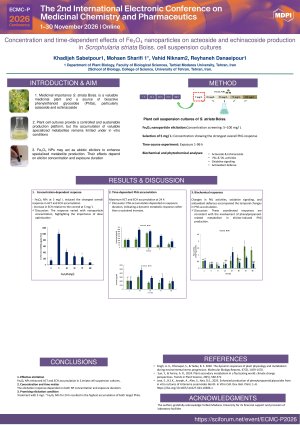
Scrophularia striata Boiss. is a valuable medicinal plant and a rich source of biologically active specialized metabolites, particularly phenylethanoid glycosides (PhGs), including acteoside and echinacoside, which possess considerable pharmaceutical and industrial potential. Plant cell culture provides a controlled and sustainable platform for the production of these valuable metabolites. However, their relatively low accumulation under in vitro conditions necessitates the development of effective elicitation strategies. In this study, the concentration- and time-dependent effects of iron oxide nanoparticles (Fe₃O₄ NPs) as a novel abiotic elicitor on specialized metabolite production in S. striata cell suspension cultures were investigated. Treatment with Fe₃O₄ NPs at concentrations ranging from 5 to 100 mg L⁻¹ induced a nonlinear response in the accumulation of acteoside and echinacoside, with the strongest overall response observed at 5 mg L⁻¹. Notably, echinacoside accumulation increased more than sevenfold compared with the control at this concentration, suggesting a hormetic response and a high sensitivity of the PhG biosynthetic pathway to nanoparticle dosage. Based on these results, 5 mg L⁻¹ was selected to investigate temporal responses over 1–96 h. Fe₃O₄ NPs induced a sequential and time-dependent response characterized by controlled oxidative signaling, coordinated antioxidant defense, enhanced activities of phenylalanine ammonia-lyase and tyrosine ammonia-lyase, and activation of the shikimate and phenylpropanoid pathways. These responses were associated with increased accumulation of PhGs. Both acteoside and echinacoside reached their maximum levels at 24 h, followed by a gradual decline and subsequent stabilization, indicating metabolic readjustment after the peak defense response. Overall, the findings demonstrate that Fe₃O₄ NPs can reprogram specialized metabolism in S. striata in a concentration- and time-dependent manner. The combination of a low nanoparticle concentration and an appropriate exposure period, particularly 24 h, represents a promising strategy for enhancing the production of valuable bioactive metabolites in S. striata cell suspension cultures.
Keywords
Acteoside; Cell suspension cultures; Echinacoside; hormetic response; Iron oxide nanoparticles; Phenylethanoid glycosides; Scrophularia striata; Secondary metabolism
Poster
Sciforum-210778.pdf
Reduction of glycosylimines: Synthetic strategies and carbonic anhydrase inhibitory activity
Zinc(II) Complexation Enhances the Antidiabetic and Antioxidant Properties of Cinnamic Acid