Event submissions
EventsThe 2nd International Electronic Conference on Medicinal Chemistry and Pharmaceutics
Published
This submission belongs to the session S2. General of the event The 2nd International Electronic Conference on Medicinal Chemistry and Pharmaceutics
Published date
28 Oct, 2026
Academic Editor
 Thierry Vandamme
Contribution&Funding
Conceptualization,
[Chika Ifeanyi Chukwuma]
Methodology,
[Chika Ifeanyi Chukwuma]
Formal analysis,
[Chika Ifeanyi Chukwuma]
Resources,
[Chika Ifeanyi Chukwuma]
Writing - original draft,
[Chika Ifeanyi Chukwuma]
Funding acquisition,
[Chika Ifeanyi Chukwuma]
Funding: --
Citation
Chika Ifeanyi Chukwuma, Zinc(II) Complexation Enhances the Antidiabetic and Antioxidant Properties of Cinnamic Acid, in Proceedings of The 2nd International Electronic Conference on Medicinal Chemistry and Pharmaceutics, 1 November–30 November 2026, MDPI: Basel, Switzerland
Share
Email
Facebook
Twitter
LinkedIn
Zinc(II) Complexation Enhances the Antidiabetic and Antioxidant Properties of Cinnamic Acid

Chika Ifeanyi Chukwuma 1
1. Centre for Quality of Health and Living, Faculty of Health and Environmental Sciences, Central University of Technology, Bloemfontein, 9301, South Africa
Abstract
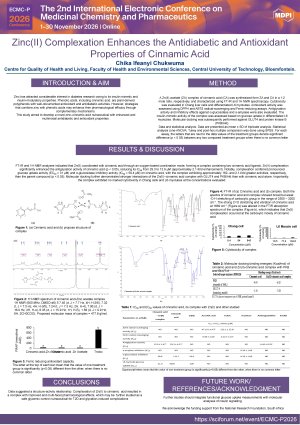
This study aimed to develop a novel zinc–cinnamic acid nutraceutical with enhanced and multimodal antidiabetic and antioxidant properties. A Zn(II) acetate complex of cinnamic acid was synthesized and characterized using FT-IR and ^1H NMR spectroscopy. Cytotoxicity was evaluated. Antioxidant activity was assessed using DPPH and ABTS radical-scavenging and Fe^3+-reducing assays. Antiglycation activity and inhibitory effects against α-glucosidase and α-amylase were also evaluated. The insulin-mimetic activity of the complex was assessed based on glucose uptake in differentiated L6 myotubes. Molecular docking was subsequently performed against GLUT4 and protein kinase B (PKB/Akt). FT-IR and ^1H NMR analyses indicated that Zn(II) coordinated with cinnamic acid through an oxygen-based coordination mode, forming a complex containing two cinnamic acid ligands. Zn(II) complexation significantly enhanced the antiglycation activity of cinnamic acid (p < 0.05), reducing its IC_50 from 29.3 to 13.9 μM (approximately 2.1-fold enhancement). Notably, complexation conferred pronounced glucose uptake activity (EC_50 = 31 μM) and α-glucosidase inhibitory activity (IC_50 = 59.4 μM) on cinnamic acid, with the complex exhibiting approximately 162- and 2.1-fold greater activities, respectively, than the parent compound (p < 0.05). Molecular docking further demonstrated stronger interactions of the Zn(II)–cinnamic acid complex with GLUT4 and PKB/Akt than with cinnamic acid alone. Importantly, the complex exhibited no marked cytotoxicity at the concentrations evaluated. The findings demonstrate a structure–activity relationship in which Zn(II) complexation substantially enhances the antidiabetic and antiglycation properties of cinnamic acid. The resulting complex exhibited multifunctional pharmacological activities, including enhanced glucose uptake, α-glucosidase inhibition and antiglycation activity, while maintaining a favourable cytotoxicity profile. These findings support further investigation of the Zn(II)–cinnamic acid complex as a potential nutraceutical candidate for glycaemic management and the prevention of diabetes-associated glycation-related complications.
Keywords
Zn(II) complex; synthesis: cinnamic acid; diabetes; antioxidant; glucose uptake
Poster
Presentation_ECMC-P 2026_Sciforum-210536.pdf
Concentration and time-dependent effects of Fe₃O₄ nanoparticles on acteoside and echinacoside production in Scrophularia striata Boiss. cell suspension cultures
Photoinactivation of different growth forms of Candida albicans mediated by porphyrin-polyethylenimine conjugates