Event submissions
EventsThe 2nd International Electronic Conference on Medicinal Chemistry and Pharmaceutics
Published
This submission belongs to the session S2. General of the event The 2nd International Electronic Conference on Medicinal Chemistry and Pharmaceutics
Published date
28 Oct, 2026
Academic Editor
 Maria Emília Sousa
Contribution&Funding
Conceptualization,
[María Gabriela Alvarez] ; [Edgardo Néstor Durantini] ; [María Elisa Milanesio] ; [Milena Belén Boarini] ; [Paula Verónica Cordero Gabrielli] ; [Lucila Luna]
Methodology,
[María Gabriela Alvarez] ; [Edgardo Néstor Durantini] ; [María Elisa Milanesio] ; [Milena Belén Boarini] ; [Lucila Luna] ; [Paula Verónica Cordero Gabrielli]
Validation,
[María Gabriela Alvarez] ; [Edgardo Néstor Durantini] ; [María Elisa Milanesio] ; [Lucila Luna] ; [Paula Verónica Cordero Gabrielli] ; [Milena Belén Boarini]
Formal analysis,
[Paula Verónica Cordero Gabrielli] ; [María Gabriela Alvarez] ; [María Elisa Milanesio] ; [Milena Belén Boarini] ; [Edgardo Néstor Durantini] ; [Lucila Luna]
Investigation,
[Lucila Luna] ; [Milena Belén Boarini] ; [María Gabriela Alvarez] ; [María Elisa Milanesio] ; [Paula Verónica Cordero Gabrielli]
Data curation,
[Edgardo Néstor Durantini] ; [Lucila Luna] ; [Milena Belén Boarini] ; [María Gabriela Alvarez] ; [Paula Verónica Cordero Gabrielli]
Writing - original draft,
[María Gabriela Alvarez]
Writing - review,
[editing] ; [Edgardo Néstor Durantini]
Visualization,
[Edgardo Néstor Durantini] ; [Milena Belén Boarini] ; [María Elisa Milanesio] ; [María Gabriela Alvarez] ; [Lucila Luna] ; [Paula Verónica Cordero Gabrielli]
Supervision,
[María Elisa Milanesio] ; [María Gabriela Alvarez] ; [Edgardo Néstor Durantini]
Project administration,
[Edgardo Néstor Durantini]
Funding acquisition,
[Edgardo Néstor Durantini]
Funding: --
Citation
María Gabriela Alvarez, Paula Verónica Cordero Gabrielli, Lucila Luna, Milena Belén Boarini, María Elisa Milanesio, Edgardo Néstor Durantini, Photoinactivation of different growth forms of Candida albicans mediated by porphyrin-polyethylenimine conjugates, in Proceedings of The 2nd International Electronic Conference on Medicinal Chemistry and Pharmaceutics, 1 November–30 November 2026, MDPI: Basel, Switzerland
Share
Email
Facebook
Twitter
LinkedIn
Photoinactivation of different growth forms of Candida albicans mediated by porphyrin-polyethylenimine conjugates

María Gabriela Alvarez 1
Paula Verónica Cordero Gabrielli 1
Lucila Luna 2
Milena Belén Boarini 1
María Elisa Milanesio 1
Edgardo Néstor Durantini 1
1. IDAS-CONICET, Departamento de Química, FCEFQYN, Universidad Nacional de Río Cuarto, Argentina
2. Departamento de Química, FCEFQYN, Universidad Nacional de Río Cuarto, Argentina
Abstract
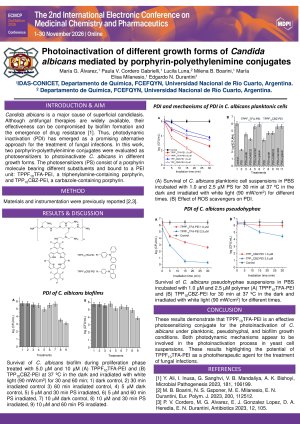
Candida albicans is a major cause of superficial candidiasis. Although antifungal therapies are widely available, their effectiveness can be compromised by biofilm formation and the emergence of drug resistance. Thus, photodynamic inactivation has emerged as a promising alternative approach for the treatment of fungal infections. In this work, two porphyrin-polyethylenimine conjugates were evaluated as photosensitizers to photoinactivate Candida albicans. Planktonic yeast suspensions (1 × 10⁶ CFU/mL) in phosphate-buffered saline (PBS) were treated with the conjugates (1.0 and 2.5 μM) for 30 min in the dark and subsequently irradiated with white light. Photoinactivation increased with both photosensitizer concentration and light fluence. Complete elimination of planktonic C. albicans was achieved with 2.5 μM TPPF10TFA-PEI after 30 min of irradiation, whereas TPP10CBZ-PEI produced a 2 log reduction in cell survival under the same conditions. Experiments using reactive oxygen species scavengers confirmed that singlet molecular oxygen was the predominant reactive species involved in the photoinactivation process for both conjugates. TPPF10TFA-PEI was also effective against C. albicans pseudohyphae in PBS, with the reduction in viability increasing with both the conjugate concentration and irradiation time. Finally, the ability of the conjugates to inhibit C. albicans biofilm development on poly(vinyl chloride) (PVC) discs was evaluated by incorporating the photosensitizers during the biofilm proliferation phase. Under these conditions, TPPF10TFA-PEI at 5.0 μM produced a 2 log reduction in biofilm viability, whereas TPP10CBZ-PEI achieved a 1 log reduction. Therefore, these results demonstrate that TPPF10TFA-PEI is an effective photosensitizing conjugate for the photoinactivation of C. albicans under planktonic, pseudohyphal, and biofilm growth conditions, highlighting its potential as a phototherapeutic agent for the treatment of fungal infections.
Keywords
Candida albicans; porphyrins; polyethylenimine; photodynamic inactivation; biofilms; reactive oxygen species.
Poster
poster Alvarez-Cordero 2026 Boarini.pdf
Zinc(II) Complexation Enhances the Antidiabetic and Antioxidant Properties of Cinnamic Acid
DNA-protective activity of selected compounds in the development of HDAC4-targeting PROTACs for spinal muscular atrophy