Event submissions
EventsThe 2nd International Electronic Conference on Medicinal Chemistry and Pharmaceutics
Published
This submission belongs to the session S2. General of the event The 2nd International Electronic Conference on Medicinal Chemistry and Pharmaceutics
Published date
28 Oct, 2026
Academic Editor
 Alfredo Berzal-Herranz
Contribution&Funding
Conceptualization,
[Sanja Lj. Matić]
Validation,
[Nevena Tomašević] ; [Milan Mladenović]
Formal analysis,
[Sanja Lj. Matić] ; [Milan Mladenović]
Investigation,
[Sanja Lj. Matić]
Resources,
[Vladimir Savić] ; [Milena R Simić] ; [Gordana Tasić] ; [Predrag Jovanović]
Data curation,
[Vladimir Savić] ; [Milena R Simić] ; [Predrag Jovanović] ; [Gordana Tasić]
Writing - original draft,
[Milan Mladenović] ; [Sanja Lj. Matić]
Writing - review,
[editing] ; [Milan Mladenović] ; [Vladimir Savić] ; [Predrag Jovanović] ; [Milena R Simić] ; [Gordana Tasić] ; [Nevena Tomašević] ; [Sanja Lj. Matić]
Visualization,
[Sanja Lj. Matić]
Supervision,
[Milan Mladenović]
Project administration,
[Milan Mladenović]
Funding: This research was supported by the Science Fund of the Republic of Serbia, #GRANT No 7490, Artificial Intelligence-Guided Design, Synthesis, and Pharmacological Evaluation of Innovative PROTACs as Degraders of HDAC4, an Epigenetic Target for Spinal Muscul
Citation
Sanja Lj. Matić, Nevena Tomašević, Gordana Tasić, Predrag Jovanović, Milena R Simić, Vladimir Savić, Milan Mladenović, DNA-protective activity of selected compounds in the development of HDAC4-targeting PROTACs for spinal muscular atrophy, in Proceedings of The 2nd International Electronic Conference on Medicinal Chemistry and Pharmaceutics, 1 November–30 November 2026, MDPI: Basel, Switzerland
Share
Email
Facebook
Twitter
LinkedIn
DNA-protective activity of selected compounds in the development of HDAC4-targeting PROTACs for spinal muscular atrophy

Sanja Lj. Matić 1

Nevena Tomašević 2
Gordana Tasić 3
Predrag Jovanović 3
Milena R Simić 3
Vladimir Savić 3

Milan Mladenović 2
1. Department of Science, University of Kragujevac, Institute for Information Technologies Kragujevac, Kragujevac, 34000, Serbia
2. Kragujevac Center for Computational Biochemistry, Faculty of Science, University of Kragujevac, Kragujevac, 34000, Serbia
3. Department of Organic Chemistry, University of Belgrade, Faculty of Pharmacy, Belgrade, 11221, Serbia
Abstract
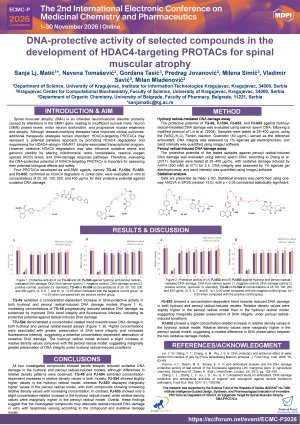
Spinal muscular atrophy (SMA) is an inherited neuromuscular disorder characterised by insufficient levels of the survival motor neuron (SMN) protein and progressive loss of motor neuron function. The disease is primarily caused by alterations in the SMN1 gene, while the paralogous SMN2 gene provides a limited source of functional SMN protein due to its predominant alternative splicing pattern. Consequently, reduced SMN availability compromises motor neuron maintenance and ultimately leads to progressive muscle weakness and atrophy. Although disease-modifying therapies have substantially improved the clinical management of SMA, the identification and characterization of additional therapeutic approaches remain important research objectives. In that sense, targeted degradation of HDAC4 using PROTAC molecules to switch off the HDAC4-atrogin 1-Murf-1 atrophy-associated transcriptional program could be a rational palliative care approach. However, selective HDAC4 degradation could trigger oxidative DNA damage in skeletal muscle by modulating maladaptive GADD45A/myogenin-associated stress signalling, mitochondrial-redox homeostasis, ROS burden, and DNA-damage response pathways involved in genome maintenance. Therefore, four PROTACs developed as anti-SMA agents, namely TG-49, PJ-594, PJ-653, and PJ-655, confirmed as HDAC4 degraders in Jurkat cells, were evaluated in vitro at concentrations of 25, 50, 100, 200, and 400 μg/mL for their protective potential against oxidative DNA damage. DNA-protective activity was assessed using assays based on hydroxyl- and peroxyl-radical-induced DNA damage. All tested compounds exhibited DNA-protective activity against both hydroxyl- and peroxyl-radical-induced oxidative damage across the entire tested concentration range. These findings demonstrate the DNA-protective potential of the investigated compounds and provide additional in vitro evidence supporting their further biological characterization.
Keywords
spinal muscular atrophy
oxidative DNA damage
hydroxyl radical
peroxyl radical
Poster
Matic et al ECMC-P 2026.pdf
Photoinactivation of different growth forms of Candida albicans mediated by porphyrin-polyethylenimine conjugates
Evolution-guided systems biology reveals host therapeutic vulnerabilities associated with the SARS-CoV-2 primase complex