Event submissions
EventsThe 2nd International Electronic Conference on Medicinal Chemistry and Pharmaceutics
Published
This submission belongs to the session S2. General of the event The 2nd International Electronic Conference on Medicinal Chemistry and Pharmaceutics
Published date
28 Oct, 2026
Academic Editor
 Alfredo Berzal-Herranz
Contribution&Funding
Conceptualization,
[Bryan John Subong]
Methodology,
[Bryan John Subong]
Software,
[Bryan John Subong]
Validation,
[Bryan John Subong]
Formal analysis,
[Bryan John Subong]
Investigation,
[Bryan John Subong]
Resources,
[Bryan John Subong]
Data curation,
[Bryan John Subong]
Writing - original draft,
[Bryan John Subong]
Funding: --
Citation
Bryan John Subong, Evolution-guided systems biology reveals host therapeutic vulnerabilities associated with the SARS-CoV-2 primase complex, in Proceedings of The 2nd International Electronic Conference on Medicinal Chemistry and Pharmaceutics, 1 November–30 November 2026, MDPI: Basel, Switzerland
Share
Email
Facebook
Twitter
LinkedIn
Evolution-guided systems biology reveals host therapeutic vulnerabilities associated with the SARS-CoV-2 primase complex

Bryan John Subong 1
1. Department of Chemistry, The University of Tokyo, Tokyo, Japan
Abstract
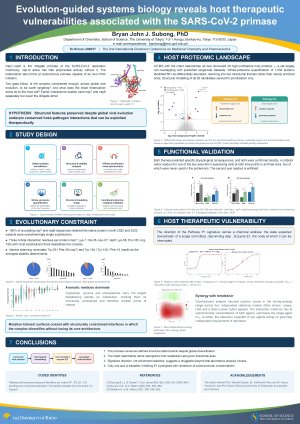
The SARS-CoV-2 primase complex, composed of nonstructural proteins 7 and 8 (nsp7–nsp8), is indispensable for viral RNA replication and represents one of the most evolutionarily constrained components of the viral replication machinery. We hypothesized that structural features preserved despite global viral evolution may underpin conserved host-pathogen interactions that can be exploited therapeutically. To investigate this, we integrated population-scale mutation surveillance, structural bioinformatics, affinity-purification mass spectrometry, quantitative proteomics, structural modelling, and functional validation to characterize the biological consequences of nsp7–nsp8 expression. Evolutionary analyses of globally circulating SARS-CoV-2 variants identified mutation-tolerant regions alongside structurally constrained interfaces predicted to be essential for primase complex stability and function, supporting the conservation of critical molecular features despite continuous viral diversification. Guided by these findings, we systematically investigated the host proteomic landscape associated with nsp7–nsp8 expression and identified coordinated remodeling of host molecular networks and cellular programs, supported by complementary structural analyses. Functional validation further demonstrated that these systems-level perturbations reveal a previously unrecognized host therapeutic vulnerability, where pharmacological modulation of a prioritized host pathway produced potent antiviral activity and enhanced efficacy when combined with an approved antiviral agent in a SARS-CoV-2 replicon model. Collectively, this study establishes an evolution-informed systems biology framework linking structural conservation of an essential viral replication complex with host-cell reprogramming and therapeutic intervention, providing a strategy for identifying host-directed antiviral targets that remain resilient to viral genetic variation.
Keywords
nsp7
nsp8
nsp7-nsp8
SARS-CoV-2
anti-virals
proteomics
population genetics
Poster
Subong_Sciforum-209057_10262026.pdf
DNA-protective activity of selected compounds in the development of HDAC4-targeting PROTACs for spinal muscular atrophy
Quinazoline Derivatives of Imino-1,2,3-dithiazoles as Pseudomonas aeruginosa Biofilm Dispersal Agents