Event submissions
EventsThe 2nd International Electronic Conference on Medicinal Chemistry and Pharmaceutics
Published
This submission belongs to the session S3. New Small Molecules as Drug Candidates of the event The 2nd International Electronic Conference on Medicinal Chemistry and Pharmaceutics
Published date
28 Oct, 2026
Academic Editor
 Alfredo Berzal-Herranz
Citation
Daphnée de Crozals, Mathieu Gonzalez, Anne-Sophie Tareau, Sylvie Chevalier, Ali Tahrioui, Emmanuelle Dé, Thierry Besson, Corinne Fruit, Quinazoline Derivatives of Imino-1,2,3-dithiazoles as Pseudomonas aeruginosa Biofilm Dispersal Agents, in Proceedings of The 2nd International Electronic Conference on Medicinal Chemistry and Pharmaceutics, 1 November–30 November 2026, MDPI: Basel, Switzerland
Share
Email
Facebook
Twitter
LinkedIn
Quinazoline Derivatives of Imino-1,2,3-dithiazoles as Pseudomonas aeruginosa Biofilm Dispersal Agents

Daphnée de Crozals 1
Mathieu Gonzalez 2,3
Anne-Sophie Tareau 2,3
Sylvie Chevalier 2,3
Ali Tahrioui 2,3,4
Emmanuelle Dé 4

Thierry Besson 1

Corinne Fruit 1
1. University of Rouen Normandy, INSA Rouen Normandie, Univ Caen Normandie, ENSICAEN, CNRS, Institut CARMeN UMR 6064, F-76000 Rouen, France
2. University of Rouen Normandy, Université Caen Normandie, Normandie Univ, CBSA UR 4312, F-76000 Rouen, France
3. Plateforme de Sécurité Sanitaire Ébroïcienne (PS2E), University of Rouen Normandy, Normandie Univ, CBSA UR 4312, F-76000 Rouen, France
4. University of Rouen Normandy, INSA Rouen Normandie, CNRS, Polymers, Biopolymers, Surfaces Laboratory UMR 6270, 76000 Rouen, France
Abstract
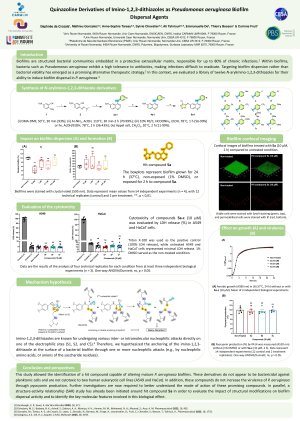
Biofilms represent a major clinical challenge, as bacteria embedded within these structures are highly tolerant of antibiotics. Among biofilm-forming pathogens, Pseudomonas aeruginosa is particularly problematic, as it forms persistent biofilms that cause acute and chronic infections, especially in immunocompromised patients.(1) Since chronic infections associated with biofilms require extensive treatment, they increase the risk of antimicrobial resistance.(2) In this context, novel therapeutic strategies are emerging, aiming to promote biofilm dispersion and thereby restore bacterial susceptibility to antimicrobial agents.
In this study, a library of thirty-six N-arylimino-1,2,3-dithiazole derivatives was investigated for their capacity to promote the dispersion of P. aeruginosa biofilms using a crystal violet-based assay.(3) The most active candidates were further evaluated to determine their impact on bacterial growth, virulence, and cytotoxicity toward human cell lines. In addition, fluorescence anisotropy experiments were performed to explore potential effects on bacterial membrane properties and provide preliminary mechanistic insights.
This study reveals that quinazoline-containing imino-1,2,3-dithiazoles exhibit biofilm-dispersing activity at micromolar concentrations. Importantly, these molecules do not impact bacterial growth dynamics of P. aeruginosa, do not enhance virulence, and exhibit no detectable cytotoxicity toward eukaryotic cells.
(1) Letizia, M.; Diggle, S. P.; Whiteley, M. Pseudomonas Aeruginosa: Ecology, Evolution, Pathogenesis and Antimicrobial Susceptibility. Nat. Rev. Microbiol. 2025, 23, 701–717. https://doi.org/10.1038/s41579-025-01193-8.
(2) Choi, V.; Rohn, J. L.; Stoodley, P.; Carugo, D.; Stride, E. Drug Delivery Strategies for Antibiofilm Therapy. Nat. Rev. Microbiol. 2023, 21, 555–572. https://doi.org/10.1038/s41579-023-00905-2.
(3) Gonzalez, M.; Tareau, A.-S.; de Crozals, D.; Layec, C.; Broudic, N.; Barreau, M.; Forge, A.; Lesouhaitier, O.; Fruit, C.; Chevalier, S.; Besson, T.; Tahrioui, A. Quinazoline-Derivatives of Imino-1,2,3-Dithiazoles Promote Biofilm Dispersion of Pseudomonas Aeruginosa. Pharmaceuticals 2025, 18, 1733. https://doi.org/10.3390/ph18111733.
Keywords
Biofilm
Imino-1,2,3-dithiazoles
Pseudomonas aeruginosa
Appel salt
Poster
Poster_ECMCP_deCROZALS-1.pdf
Evolution-guided systems biology reveals host therapeutic vulnerabilities associated with the SARS-CoV-2 primase complex
Design, Microwave-Assisted Synthesis and Druglikeness Evaluation of Two Chloroquine-Based Hybrids for Improved Resistance Profiles Against Malaria