Event submissions
EventsThe 2nd International Electronic Conference on Medicinal Chemistry and Pharmaceutics
Published
This submission belongs to the session S3. New Small Molecules as Drug Candidates of the event The 2nd International Electronic Conference on Medicinal Chemistry and Pharmaceutics
Published date
28 Oct, 2026
Academic Editor
 Mary J. Meegan
Citation
William Le Boeuf, Praveen P Nekkar Rao, Developing Novel Molecules to Prevent Amyloid-Beta Aggregation, in Proceedings of The 2nd International Electronic Conference on Medicinal Chemistry and Pharmaceutics, 1 November–30 November 2026, MDPI: Basel, Switzerland
Share
Email
Facebook
Twitter
LinkedIn
Developing Novel Molecules to Prevent Amyloid-Beta Aggregation

William Le Boeuf 1

Praveen P Nekkar Rao 1
1. School of Pharmacy, University of Waterloo, Waterloo, N2G1C5, Canada
Abstract
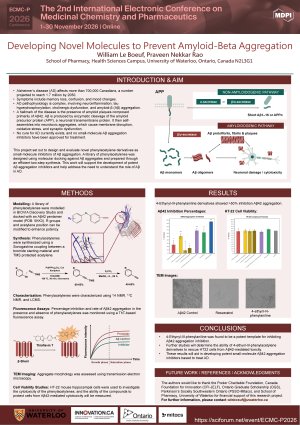
Alzheimer’s Disease (AD) affects and estimated 700,000 Canadians, a figure projected to grow to 1.7 million by 2050. Current treatment options are limited and there is no cure for the disease. One of the prevailing explanations for the cause of AD is the amyloid hypothesis, which posits that aggregates of amyloid-beta (Aβ) are the initiating pathological agents. Aβ self-assembles in the brain of AD patients, and these aggregates cause neuronal damage through several routes, including oxidative stress, membrane dysfunction, and causing synaptic dysfunction. Small molecules capable of inhibiting or modulating the formation of Aβ aggregates are therefore valuable both as potential therapeutics and as tools for understanding disease progression.
This project involves designing and evaluating novel phenylacetylene derivatives as inhibitors of Aβ aggregation. A novel compound library was designed using molecular docking with Aβ aggregate models, then synthesized using a two-step procedure: a Sonogashira coupling between an aryl bromide and trimethylsilylacetylene, followed by a base-catalyzed deprotection. Products were then characterized using 1H NMR, 13C NMR, and LCMS to confirm purity.
The ability of these phenylacetylenes to prevent Aβ aggregation was assessed using a fluorescence-based kinetics assay. Aggregate morphology in the presence of promising inhibitors was assessed using transmission electron microscopy (TEM). The safety profile of the phenylacetylenes was tested in mouse hippocampal (HT 22) neuronal cells. Future work will further test their ability to rescue neuronal cells from Aβ-mediated cytotoxicity.
The data collected in this project will be used to develop a structure activity relationship (SAR) for phenylacetylenes to determine their potency in inhibiting Aβ aggregation. This work will contribute to both the development of potent small-molecule Aβ aggregation inhibitors, and to help understand the role Aβ aggregates play in Alzheimer’s disease.
Keywords
Small Molecules
Structure-Activity Relationships
Alzheimer's Disease
Amyloid Beta
Poster
wleboeuf_ECMC-P Poster.pdf
Turning Down ROCK Signaling in Pulmonary Fibrosis: Novel 1,2,4-Triazole-Based Antifibrotic Candidates
Evaluating the cell cycle modulation activity of synthetic halogenated chalcogens