Event submissions
EventsThe 2nd International Electronic Conference on Medicinal Chemistry and Pharmaceutics
Published
This submission belongs to the session S3. New Small Molecules as Drug Candidates of the event The 2nd International Electronic Conference on Medicinal Chemistry and Pharmaceutics
Published date
28 Oct, 2026
Academic Editor
 Mary J. Meegan
Citation
Daria Andreyevna Likhobabina, Alexey Nikolaevich Noev, Nikita Vladimirovich Suvorov, Mikhail Aleksandrovich Grin, Optimization of the conditions for the nucleophilic aromatic substitution reaction of 2,4,5‑trichloropyrimidine, in Proceedings of The 2nd International Electronic Conference on Medicinal Chemistry and Pharmaceutics, 1 November–30 November 2026, MDPI: Basel, Switzerland
Share
Email
Facebook
Twitter
LinkedIn
Optimization of the conditions for the nucleophilic aromatic substitution reaction of 2,4,5‑trichloropyrimidine

Daria Andreyevna Likhobabina 1
Alexey Nikolaevich Noev 1,2
Nikita Vladimirovich Suvorov 1
Mikhail Aleksandrovich Grin 1
1. Department of Chemistry and Technology of Biologically Active Compounds, Medical and Organic Chemistry named after N.A. Preobrazhensky, Institute of Fine Chemical Technologies named after M.V. Lomonosov, Federal State Budgetary Educational Institution of Higher Education "MIREA – Russian Technological University", Moscow, Russia
2. Department of Pharmacology of Biomedical Preparations, P.A. Herzen Moscow Oncology Research Institute – Branch of the Federal State Budgetary Institution "National Medical Research Center of Radiology" of the Ministry of Health of Russia, Moscow, Russia
Abstract
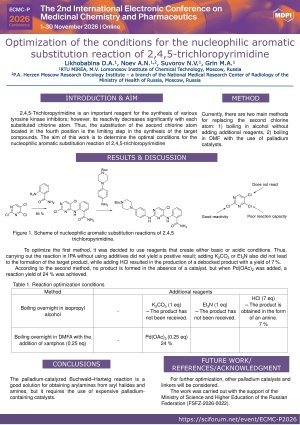
2,4,5-Trichloropyrimidine is an important reagent for the synthesis of various tyrosine kinase inhibitors; however, its reactivity decreases significantly with each substituted chlorine atom. Thus, the substitution of the second chlorine atom located in the fourth position is the limiting step in the synthesis of the target compounds.
Currently, there are two main methods for replacing the second chlorine atom: 1) heating in alcohol without adding additional reagents, 2) heating in DMF with the use of palladium catalysts.
To optimize the first method, reagents were used to create either basic or acidic conditions. Thus, carrying out the reaction in IPA without using additives did not yield a positive result; adding K2CO3 or Et3N also did not lead to the formation of the target product, while adding HCl resulted in the production of product without Boc with a yield of 7 %.
According to the second method, no product is formed in the absence of a catalyst, but when Pd(OAc)2 was added, a reaction yield of 24 % was achieved. Other palladium catalysts will be considered for further optimization.
The work was carried out with the support of the Ministry of Science and Higher Education of the Russian Federation (FSFZ-2026-0022).
Keywords
tyrosine kinase inhibitors
nucleophilic aromatic substitution
Poster
Poster.pdf
Evaluating the cell cycle modulation activity of synthetic halogenated chalcogens
Benzylidene-9(10H)-anthracenones: Synthesis, SAR and Binding Mode of a novel CK2 Inhibitor Class