Event submissions
EventsThe 2nd International Electronic Conference on Medicinal Chemistry and Pharmaceutics
Published
This submission belongs to the session S3. New Small Molecules as Drug Candidates of the event The 2nd International Electronic Conference on Medicinal Chemistry and Pharmaceutics
Published date
28 Oct, 2026
Academic Editor
 Mary J. Meegan
Citation
Thomas Bödeker, Christian Werner, Helge Prinz, Karsten Niefind, Joachim Jose, Benzylidene-9(10H)-anthracenones: Synthesis, SAR and Binding Mode of a novel CK2 Inhibitor Class, in Proceedings of The 2nd International Electronic Conference on Medicinal Chemistry and Pharmaceutics, 1 November–30 November 2026, MDPI: Basel, Switzerland
Share
Email
Facebook
Twitter
LinkedIn
Benzylidene-9(10H)-anthracenones: Synthesis, SAR and Binding Mode of a novel CK2 Inhibitor Class

Thomas Bödeker 1
Christian Werner 2
Helge Prinz 1

Karsten Niefind 2

Joachim Jose 1
1. Institut für Pharmazeutische und Medizinische Chemie, University of Münster, Münster, 48149, Germany
2. Institute of Biochemistry, University of Cologne, Köln, 50923, Germany
Abstract
The human protein kinase CK2 is a constitutively active and ubiquitously expressed serine/threonine kinase involved in numerous cellular processes, including cell survival and proliferation, cell cycle progression and regulation of apoptosis. These functions are primarily mediated through phosphorylation of hundreds of substrates, thereby modulating key signaling pathways. Structurally, CK2 is a tetramer, which consists of two catalytic (a or a') and two regulatory (ß) subunits. In several cancer cells, where CK2 is overexpressed, the phosphorylation of CK2 substrates promotes tumorigenesis and inhibits apoptosis. Consequently, inhibition of CK2 represents a promising strategy for cancer therapy. [1]
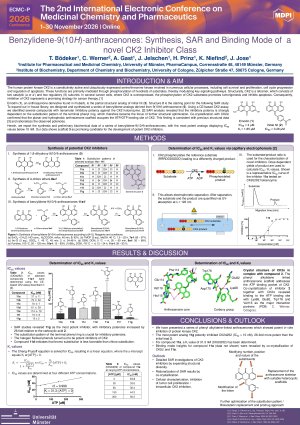
To expand our in-house library, we designed and synthesized a series of benzylidene-analogs derived from 9(10H)-anthracenone. Using a CE-based CK2 assay, we identified several compounds with nanomolar inhibitory potency against the CK2 holoenzyme. [2] SAR analysis revealed that the inhibitory potency is strongly dependent on the substitution pattern of the terminal phenyl ring, which therefore became the focus of further structural optimization.
Co-crystallization with CK2a' confirmed that the planar and hydrophobic anthracenone scaffold occupies the ATP/GTP binding site of CK2. This finding is consistent with previous structural data [3] and rationalizes the observed potencies.
Herein, we report the synthesis and preliminary biochemical data of a series of benzylidene-9(10H)-anthracenones, with the most potent analogs displaying IC50 values below 20 nM. Our data shows 9(10H)-anthracenone derived inhibitors as promising candidates for the development of potent CK2 inhibitors.
[1] C. Borgo, C. D'Amore et al., Sig. Transduct. Target. Ther. 2021, 6, 183. [2] A. Gratz, C. Götz et al., Electrophoresis 2010, 31, 634–640. [3] Y. Chen, Y. Wang et al., J. Med. Chem. 2023, 66, 2257–2281.
Keywords
SAR
Inhibitors,
Cancer
Synthesis
Drug design
CK2
Kinase inhibitors
small molecules
capillary electrophoresis
Lead optimization
Medicinal chemistry
Organic synthesis
Enzyme inhibition assay
In vitro assay
Small molecule inhibitors
Poster
ECMC_HB.pdf
Optimization of the conditions for the nucleophilic aromatic substitution reaction of 2,4,5‑trichloropyrimidine
Synthesis and evaluation of anticancer activity of spiro-fused pyrrolo[3,4-c]pyrroles against tumor cell lines