Event submissions
EventsThe 2nd International Electronic Conference on Medicinal Chemistry and Pharmaceutics
Published
This submission belongs to the session S3. New Small Molecules as Drug Candidates of the event The 2nd International Electronic Conference on Medicinal Chemistry and Pharmaceutics
Published date
28 Oct, 2026
Academic Editor
 Mary J. Meegan
Citation
Andrey Drachuk, Yuliya Pronina, Sergey Mkrtchyan, Alexander Stepakov, Vitali Boitsov, Synthesis and evaluation of anticancer activity of spiro-fused pyrrolo[3,4-c]pyrroles against tumor cell lines, in Proceedings of The 2nd International Electronic Conference on Medicinal Chemistry and Pharmaceutics, 1 November–30 November 2026, MDPI: Basel, Switzerland
Share
Email
Facebook
Twitter
LinkedIn
Synthesis and evaluation of anticancer activity of spiro-fused pyrrolo[3,4-c]pyrroles against tumor cell lines

Andrey Drachuk 1
Yuliya Pronina 2
Sergey Mkrtchyan 1
Alexander Stepakov 2
Vitali Boitsov 1
1. Department of Nanobiotechnology, Saint Petersburg National Research Academic University of the Russian Academy of Sciences, Saint Petersburg, Russia
2. Department of Organic chemistry, Saint-Petersburg State Institute of Technology, Saint Petersburg, Russia
Abstract
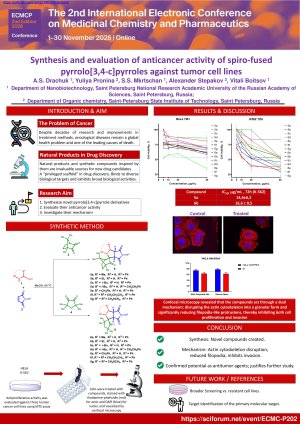
Oncological diseases remain a major global health challenge and one of the leading causes of mortality despite decades of research and improvements in multimodal treatment strategies including radiation, surgery, and chemotherapy. Therefore discovery of novel chemotherapeutic agents with improved efficacy and safety profiles as well as methods of their target delivery remains a critical objective in medicinal chemistry. Heterocyclic compounds, particularly spirocyclic pyrrolo[3,4-c]pyrrole derivatives, are privileged scaffolds in drug design.
This study devoted to the development of synthetic methods and the study of the biological activity of new, first‑synthesized classes of spirocyclic compounds, namely spiro-fused pyrrolo[3,4-c]pyrroles, pyrrolo[3,4-a]pyrrolizines, and pyrrolo[3′,4′:3,4]pyrrolo[1,2-c]thiazoles containing tetramethylcyclopentane and camphor moieties. These classes of compounds were obtained as a result of 1,3‑dipolar cycloaddition reactions of differently substituted maleimides to azomethine ylides, which were first synthesized by condensing camphoroquinone and cyclopentanedione with various α‑amino acids. These cycloadditions proceed smoothly under optimized reaction conditions to give corresponding products in moderate to good yields and moderate to high diastereoselectivity.
The synthesized compounds were preliminary screened for their in vitro antiproliferative activity against the human erythroleukemia cell line K-562 by the standard MTS assay.
The results revealed that several adducts exhibited significant cytotoxic effects, with half-maximal inhibitory concentration (IC₅₀) values as potent as 15 μg/mL. These findings substantiate the promising antitumor potential of the synthesized spirocyclic derivatives and warrant further investigation.
Keywords
[3+2] cycloaddition; azomethine ylides; α-diketones; maleimides; α-amino acids; cyclopentane-1,2-dione; camphorquinone; spirocyclic compounds; diastereoselectivity; anticancer activity; K-562 cells
Poster
MDPIconf.Poster2026_DrachukAS.pdf
Benzylidene-9(10H)-anthracenones: Synthesis, SAR and Binding Mode of a novel CK2 Inhibitor Class
Mechanosynthesis and Biological Evaluation of Valproic Acid–Based Dual-Pharmacophore Hybrids