Event submissions
EventsThe 2nd International Electronic Conference on Medicinal Chemistry and Pharmaceutics
Published
This submission belongs to the session S3. New Small Molecules as Drug Candidates of the event The 2nd International Electronic Conference on Medicinal Chemistry and Pharmaceutics
Published date
28 Oct, 2026
Academic Editor
 Alfredo Berzal-Herranz
Contribution&Funding
Conceptualization,
[Vladislava Shramenko] ; [Alexander V. Bespalov] ; [Victor V. Dotsenko]
Methodology,
[Vladislava Shramenko] ; [Alexander V. Bespalov] ; [Victor V. Dotsenko]
Software,
[Alexander V. Bespalov] ; [Victor V. Dotsenko]
Investigation,
[Vladislava Shramenko]
Resources,
[Victor V. Dotsenko]
Writing - original draft,
[Vladislava Shramenko]
Visualization,
[Vladislava Shramenko]
Project administration,
[Vladislava Shramenko]
Funding acquisition,
[Victor V. Dotsenko]
Funding: --
Citation
Vladislava Shramenko, Alexander V. Bespalov, Victor V. Dotsenko, Synthesis-Driven In Silico Exploration of Functionalized Indolin-2-One Heterodimers: Reverse Docking, ADMET, and Antibacterial Evaluation, in Proceedings of The 2nd International Electronic Conference on Medicinal Chemistry and Pharmaceutics, 1 November–30 November 2026, MDPI: Basel, Switzerland
Share
Email
Facebook
Twitter
LinkedIn
Synthesis-Driven In Silico Exploration of Functionalized Indolin-2-One Heterodimers: Reverse Docking, ADMET, and Antibacterial Evaluation

Vladislava Shramenko 1
Alexander V. Bespalov 1
Victor V. Dotsenko 1,2
1. Department of Organic Chemistry and Technologies, Kuban State University, Krasnodar, 350040, Russia
2. Department of Chemistry, North-Caucasus Federal University, Stavropol, 355017, Russia
Abstract
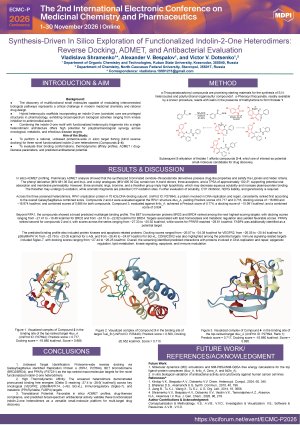
The discovery of multifunctional small molecules addressing interconnected biological pathways represents an urgent challenge in modern medicinal chemistry and drug design. In this work, we report the rational exploration and multifaceted in silico profiling of novel functionalized heterocyclic heterodimers as prospective bioactive candidates. Initial structural optimization in the MM2 force field was coupled with proteome-wide blind reverse docking via the GalaxySagittarius protocol (GalaxyWeb platform) to identify putative pharmacological targets without prior bias. The screened compounds exhibited pronounced multitarget affinity profiles (binding free energies reaching −27.4 kcal/mol) across several clinically validated disease-modifying axes: immune checkpoint modulation (Siglec-7, ΔG = −27.4...−26.2 kcal/mol), lipid homeostasis and metabolic regulation (PPARγ and FABP4), oncogenic protein kinases governing cell cycle and neoangiogenesis (VEGFR2, CDK6, p38α/MAPK14, and c-Abl, ΔG up to −26.1 kcal/mol), and epigenetic transcriptional readers (BET family bromodomains BRD2 and BRD4). Focused molecular docking utilizing AutoDock Vina was additionally engaged to refine specific ligand–receptor binding conformations and binding energies at the active sites. The pharmacokinetic profile, gastrointestinal absorption, membrane permeability, and safety endpoints were evaluated through in silico ADMET prediction, highlighting favorable drug-likeness and absence of critical liability alerts. Furthermore, computational assessment of antibacterial potential indicated promising broad-spectrum antibacterial capability. Together, these preliminary findings validate this novel hybrid architecture as a versatile small-molecule platform with high translational value for oncology, metabolic disorders, and infectious disease therapies.
Keywords
small molecules; blind docking; AutoDock; ADMET; protein kinases; antibacterial activity; drug discovery
Poster
ecmc 2 Shramenko.pdf
New Profen-Derived Methoxyaryl Ketones: Synthesis and Structural Characterization
Investigation of the mechanism of action of a selective inhibitor of the main protease of beta-coronaviruses using the recombinant 3CLpro protein