Event submissions
EventsThe 2nd International Electronic Conference on Medicinal Chemistry and Pharmaceutics
Published
This submission belongs to the session S3. New Small Molecules as Drug Candidates of the event The 2nd International Electronic Conference on Medicinal Chemistry and Pharmaceutics
Published date
28 Oct, 2026
Academic Editor
 Mary J. Meegan
Contribution&Funding
Conceptualization,
[Timur Garaev]
Methodology,
[Timur Garaev] ; [Alexei Prilipov]
Software,
[Timur Garaev]
Validation,
[Maria Sergeevtseva] ; [Alexei Prilipov]
Formal analysis,
[Maria Sergeevtseva] ; [Alexei Prilipov]
Investigation,
[Maria Sergeevtseva]
Data curation,
[Alexei Prilipov]
Writing - original draft,
[Timur Garaev]
Writing - review,
[editing] ; [Timur Garaev]
Supervision,
[Timur Garaev] ; [Tatiana Grebennikova]
Project administration,
[Tatiana Grebennikova]
Funding: --
Citation
Ilya Yudin, Tatiana Grebennikova, Timur Garaev, Maria Sergeevtseva, Alexei Prilipov, Investigation of the mechanism of action of a selective inhibitor of the main protease of beta-coronaviruses using the recombinant 3CLpro protein, in Proceedings of The 2nd International Electronic Conference on Medicinal Chemistry and Pharmaceutics, 1 November–30 November 2026, MDPI: Basel, Switzerland
Share
Email
Facebook
Twitter
LinkedIn
Investigation of the mechanism of action of a selective inhibitor of the main protease of beta-coronaviruses using the recombinant 3CLpro protein

Ilya Yudin 1

Tatiana Grebennikova 1
Timur Garaev 1
Maria Sergeevtseva 2
Alexei Prilipov 2
1. Molecular Diagnostics Laboratory, The National Research Center for Epidemiology and Microbiology named after Honorary Academician N.F. Gamaleya of the Ministry of Health of the Russian, Moscow, Russia
2. Molecular Genetics Laboratory, The National Research Center for Epidemiology and Microbiology named after Honorary Academician N.F. Gamaleya of the Ministry of Health of the Russian, Moscow, Russia
Abstract
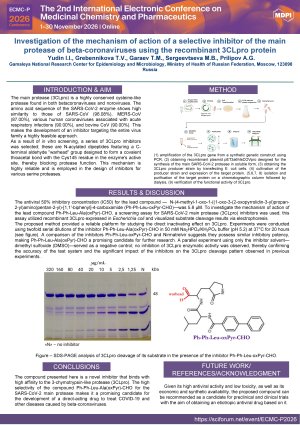
As a result of in vitro screening, a number of 3CLpro inhibitors were identified as an N-acylated dipeptide with the C-terminal aldehyde group (“warhead”), which forms a thioacetal covalent bond with cysteine residue 145 (Cys145) in the enzyme’s active site to block protease function. This mechanism is quite reliable and applied in the design of various serine proteases inhibitors. IC50 of the lead compound—N-(4-methyl-1-oxo-1- ((1-oxo-3-(2-oxopyrrolidin-3-yl)propan-2-yl)amino)pentan-2-yl)-[1,1'-biphenyl]-4-carboxamide (Ph-Ph-Leu-oxPyr-CHO) was 5.8 mM. A test system for screening inhibitors of the main SARS-CoV-2 protease (3CLpro), based on the use of recombinant 3CLpro expressed in Escherichia coli and the visualization of substrate cleavage results via electrophoresis was used to investigate the mechanism of action of the lead compound Ph-Ph-Leu-oxPyr-CHO. The proposed method provided a reliable platform for studying the direct inactivating effect on 3CLpro. Experiments were conducted using twofold dilutions of the inhibitor Ph-Ph-Leu-oxPyr-CHO in 50 mM Na₂HPO₄/KH₂PO₄ buffer (pH 5.2) at 37°C for 20 hours. The results of the comparison between the Ph-Ph-Leu-oxPyr-CHO and Nirmatrelvir inhibitors suggest that the inhibitors have similar inhibitory activity, making Ph-Ph-Leu-oxPyr-CHO a promising candidate for further research. As a negative control, similar experiment was conducted using only the inhibitor solvent dimethyl sulfoxide (DMSO); no inhibition of 3CLpro enzymatic activity was observed, confirming the accuracy of the assay system and the significant effect of the inhibitors on the 3CLpro cleavage profile in the previous experiments.
Keywords
SARS-CoV-2
3CLPro
antiviral therapy
peptidomimetic
Poster
Investigation of the mechanism of action of a selective inhibitor of the main protease of beta-coronaviruses using the recombinant 3CLpro protein.pdf
Synthesis-Driven In Silico Exploration of Functionalized Indolin-2-One Heterodimers: Reverse Docking, ADMET, and Antibacterial Evaluation
2-Formylpyridine 4-Allylthiosemicarbazone Copper(II) Complexes: Enhanced Anticancer Activity against THP-1 Cells