Event submissions
EventsThe 2nd International Electronic Conference on Medicinal Chemistry and Pharmaceutics
Published
This submission belongs to the session S3. New Small Molecules as Drug Candidates of the event The 2nd International Electronic Conference on Medicinal Chemistry and Pharmaceutics
Published date
28 Oct, 2026
Academic Editor
 Mary J. Meegan
Contribution&Funding
Funding: This work was fulfilled with the financial support of the Bilateral Research Project 26.80013.8007.02MDTR, funded by NARD.
Citation
Vasilii Graur, Ianina Graur, Olga Garbuz, Aurelian Gulea, 2-Formylpyridine 4-Allylthiosemicarbazone Copper(II) Complexes: Enhanced Anticancer Activity against THP-1 Cells, in Proceedings of The 2nd International Electronic Conference on Medicinal Chemistry and Pharmaceutics, 1 November–30 November 2026, MDPI: Basel, Switzerland
Share
Email
Facebook
Twitter
LinkedIn
2-Formylpyridine 4-Allylthiosemicarbazone Copper(II) Complexes: Enhanced Anticancer Activity against THP-1 Cells

Vasilii Graur 1
Ianina Graur 1
Olga Garbuz 2
Aurelian Gulea 1
1. Laboratory of Advanced Materials in Biopharmaceutics and Technics, Institute of Chemistry, Moldova State University, Moldova
2. Laboratory of Systematics and Molecular Phylogenetics, Institute of Zoology, Moldova State University, Moldova
Abstract
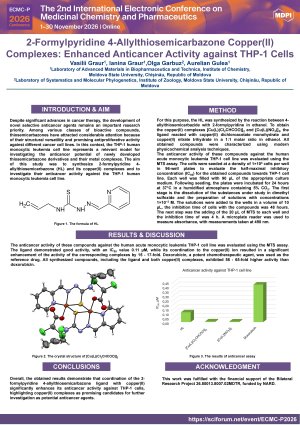
Despite significant advances in cancer therapy, the development of novel selective anticancer agents remains an important research priority. Among various classes of bioactive compounds, thiosemicarbazones have attracted considerable attention because of their structural versatility and promising antiproliferative activity against different cancer cell lines. In this context, the THP-1 human monocytic leukemia cell line represents a relevant model for investigating the anticancer potential of newly developed thiosemicarbazone derivatives and their metal complexes. The aim of this study was to synthesize 2-formylpyridine 4-allylthiosemicarbazone (HL) and its copper(II) complexes and to investigate their anticancer activity against the THP-1 human monocytic leukemia cell line.
For this purpose, the HL was synthesized by the reaction between 4-allylthiosemicarbazide with 2-formylpyridine in ethanol. To obtain the copper(II) complexes [Cu(L)(Cl2CHCOO)]2 and [Cu(L)(NO3)]2, the ligand reacted with copper(II) dichloroacetate monohydrate and copper(II) nitrate trihydrate in a 1:1 molar ratio in ethanol. All obtained compounds were characterized using modern physicochemical analysis techniques.
The anticancer activity of these compounds against the human acute monocytic leukemia THP-1 cell line was evaluated using the MTS assay. The ligand demonstrated good activity, with an IC50 value 0.11 µM, while its coordination to the copper(II) ion resulted in a significant enhancement of the activity of the corresponding complexes by 15 - 17-fold.
Overall, the obtained results demonstrate that coordination of the 2-formylpyridine 4-allylthiosemicarbazone ligand with copper(II) significantly enhances its anticancer activity against THP-1 cells, highlighting copper complexes as promising candidates for further investigation as potential anticancer agents.
This work was fulfilled with the financial support of the Bilateral Research Project 26.80013.8007.02MDTR, funded by NARD.
Keywords
copper(II) complexes
THP-1 cell line
anticancer activity
Poster
Poster VGraur revised.pdf
Investigation of the mechanism of action of a selective inhibitor of the main protease of beta-coronaviruses using the recombinant 3CLpro protein
Design, Synthesis, and Biological Evaluation of Novel Anthranilate Derivatives as Potential NLRP3 Inhibitors