Event submissions
EventsThe 2nd International Electronic Conference on Medicinal Chemistry and Pharmaceutics
Published
This submission belongs to the session S3. New Small Molecules as Drug Candidates of the event The 2nd International Electronic Conference on Medicinal Chemistry and Pharmaceutics
Published date
28 Oct, 2026
Academic Editor
 Mary J. Meegan
Contribution&Funding
Supervision,
[Ahmed Thabet Negmeldin] ; [Eman Moussa El-labbad]
Funding: --
Citation
Aysha Jasim Basalar, Ahmed Thabet Negmeldin, Eman Moussa El-labbad, Design, Synthesis, and Biological Evaluation of Novel Anthranilate Derivatives as Potential NLRP3 Inhibitors, in Proceedings of The 2nd International Electronic Conference on Medicinal Chemistry and Pharmaceutics, 1 November–30 November 2026, MDPI: Basel, Switzerland
Share
Email
Facebook
Twitter
LinkedIn
Design, Synthesis, and Biological Evaluation of Novel Anthranilate Derivatives as Potential NLRP3 Inhibitors

Aysha Jasim Basalar 1
Ahmed Thabet Negmeldin 1
Eman Moussa El-labbad 2
1. Department of Pharmaceutical Sciences, College of Pharmacy, Gulf Medical University, Ajman, United Arab Emirates
2. Pharmaceutical Chemistry Department, Faculty of Pharmacy, Ain Shams University, Cairo, Egypt
Abstract
Aim
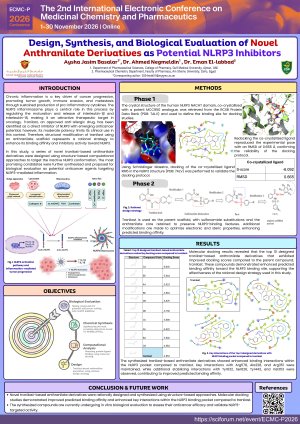
Chronic inflammation contributes to tumor initiation and progression, with the NLRP3 inflammasome promoting IL-1β–mediated signaling, angiogenesis, and immune evasion. Tranilast, an anthranilate derivative, directly inhibits NLRP3 oligomerization and serves as a promising scaffold for next-generation inhibitors. This study aims to design and synthesize novel Tranilast-based anthranilate derivatives with improved predicted binding to the inactive conformation of NLRP3.
Methods
A structure-based drug design approach guided scaffold modifications, with preliminary molecular docking used to prioritize promising substitution patterns. The designed derivatives were synthesized through a multistep pathway centered on an anthranilate scaffold, incorporating sulfonamide introduction and subsequent structural refinements. The synthesized compounds were purified and characterized using melting point determination, thin-layer chromatography, infrared spectroscopy, and nuclear magnetic resonance and mass spectrometric analysis.
Key Findings
The synthetic workflow successfully produced a diverse series of anthranilate-based derivatives through sulfonamide formation and further scaffold modifications. Each step proceeded efficiently under optimized conditions, yielding structurally clean intermediates and final compounds verified by spectroscopy. Preliminary docking supported the design rationale by predicting favorable interactions with inactive NLRP3. The resulting compound library demonstrates the practicality of the synthetic strategy and provides tranilast-based derivatives ready for subsequent biological evaluation.
Conclusion
This study establishes a rational workflow integrating scaffold redesign, docking-based prioritization, and synthetic chemistry to generate new anthranilate derivatives with improved predicted affinity for NLRP3. The synthesized and characterized compounds will be subjected to future biological screening to evaluate their ability to modulate NLRP3-mediated inflammatory responses and to determine their potential as anticancer and anti-inflammatory candidates.
Keywords
NLRP3
tranilast
cancer inflammation
drug design
anthranilate derivatives
Poster
Poster - Aysha.pdf
2-Formylpyridine 4-Allylthiosemicarbazone Copper(II) Complexes: Enhanced Anticancer Activity against THP-1 Cells
Pyruvic Acid 4-Allylthiosemicarbazone and Its Metal Complexes as Agents for Free Radical Neutralization