Event submissions
EventsThe 2nd International Electronic Conference on Medicinal Chemistry and Pharmaceutics
Published
This submission belongs to the session S3. New Small Molecules as Drug Candidates of the event The 2nd International Electronic Conference on Medicinal Chemistry and Pharmaceutics
Published date
28 Oct, 2026
Academic Editor
 Alfredo Berzal-Herranz
Contribution&Funding
Funding: This work was fulfilled with the financial support of the subprograms 010602 and 010701 of the institutional project.
Citation
Ianina Graur, Vasilii Graur, Olga Garbuz, Aurelian Gulea, Pyruvic Acid 4-Allylthiosemicarbazone and Its Metal Complexes as Agents for Free Radical Neutralization, in Proceedings of The 2nd International Electronic Conference on Medicinal Chemistry and Pharmaceutics, 1 November–30 November 2026, MDPI: Basel, Switzerland
Share
Email
Facebook
Twitter
LinkedIn
Pyruvic Acid 4-Allylthiosemicarbazone and Its Metal Complexes as Agents for Free Radical Neutralization

Ianina Graur 1
Vasilii Graur 1
Olga Garbuz 2
Aurelian Gulea 1
1. Laboratory of Advanced Materials in Biopharmaceutics and Technics, Institute of Chemistry, Moldova State University, Chișinău, Moldova
2. Laboratory of Systematics and Molecular Phylogenetics, Institute of Zoology, Moldova State University, Chișinău, Moldova
Abstract
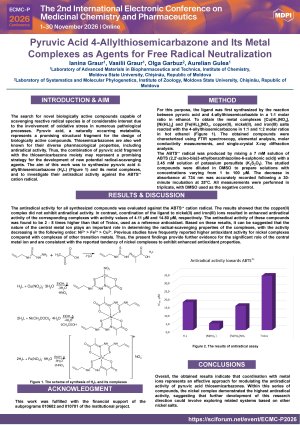
The search for novel biologically active compounds capable of scavenging reactive radical species is of considerable interest due to the involvement of oxidative stress in numerous pathological processes. Pyruvic acid, a naturally occurring metabolite, represents a promising structural fragment for the design of biologically active compounds. Thiosemicarbazones are also well known for their diverse pharmacological properties, including antiradical activity. Thus, the combination of pyruvic acid fragment with the thiosemicarbazone moiety may represent a promising strategy for the development of new potential radical-scavenging agents. The aim of this work was to synthesize pyruvic acid 4-allylthiosemicarbazone (H2L) and its metal complexes, and to investigate their antiradical activity against the ABTS•+ cation radical.
For this purpose, the ligand was first synthesized by the reaction between pyruvic acid and 4-allylthiosemicarbazide in a 1:1 molar ratio in ethanol. To obtain the metal complexes [Cu(HL)NO3], [Ni(HL)2] and [Fe(HL)2]NO3, copper(II), nickel(II), and iron(III) salts reacted with the 4-allylthiosemicarbazone in 1:1 and 1:2 molar ratios in hot ethanol. The obtained compounds were characterized using FTIR spectroscopy, elemental analysis, molar conductivity measurements, and single-crystal X-ray diffraction analysis.
The antiradical activity for all synthesized compounds was evaluated against the ABTS•+ cation radical. The results showed that the copper(II) complex did not exhibit antiradical activity. In contrast, coordination of the ligand to nickel(II) and iron(III) ions resulted in enhanced antiradical activity of the corresponding complexes with activity values of 4.11 µM and 14.80 µM, respectively. The antiradical activity of these compounds was found to be 2 - 8 times higher than that of Trolox, used as a reference antioxidant.
This work was fulfilled with the financial support of the subprograms 010602 and 010701 of the institutional project.
Keywords
pyruvic acid
metal complexes
antiradical activity
Poster
Poster Graur Ianina revised.pdf
Design, Synthesis, and Biological Evaluation of Novel Anthranilate Derivatives as Potential NLRP3 Inhibitors
Synthesis of tetraketones and determination their biological activity